Your colon cells really need better boundaries. Faced with enterotoxigenic Bacteroides fragilis - ETBF, a bacterium with all the charm of a smoke alarm at 3 a.m. - they seem to get bullied into changing their metabolism in a way that helps the microbe settle in and thrive. Not ideal. Especially since ETBF has already been linked to colitis and colorectal cancer.
A new Cell paper asks a sneaky question: how does an anaerobic bug - one that supposedly prefers life without oxygen - manage to do so well in the inflamed gut, where the rules are already weird and crowded? The answer, it turns out, is that ETBF does not just show up and eat what's on the table. It rearranges the kitchen.
The bug that flips the neighborhood
The large intestine is usually a low-oxygen zone. That's why anaerobic microbes love it. ETBF belongs in that camp, at least on paper. But this study found that ETBF uses its toxin, Bacteroides fragilis toxin or BFT, to reshape the local environment so it can tap into something more oxidative.
That sounds contradictory because it is. Cancer biology has taught us many things, including that cells are messy and biology enjoys plot twists more than any prestige TV writer.
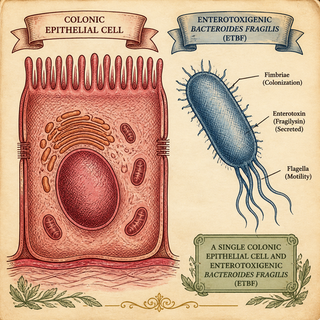
The researchers show that BFT messes with colonic epithelial cells - the lining cells of the colon - and also alters bile acid recycling. Those host changes push colon cells away from oxidative phosphorylation and toward glycolysis. In plain English: the cells start burning fuel in a faster, less efficient way, kind of like panic-ordering takeout because the stove is on fire.
That metabolic switch leaves behind more lactate and more local oxygen. ETBF then uses those conditions to support its own oxidative metabolism and colonization. So the bug creates a niche that suits it, even if that means making the host tissue more inflamed and metabolically scrambled.
Wait - an anaerobe likes oxygen now?
Sort of. More accurately, this paper suggests ETBF is not a simple "oxygen bad, no oxygen good" organism. It can exploit a localized oxidative niche when it manufactures one. That's the clever bit.
Microbes in the gut do not just passively float around waiting for lunch. They compete, sabotage, negotiate, and occasionally behave like tiny crime bosses. ETBF appears to use a virulence factor not just to damage tissue, but to reprogram host metabolism into making useful nutrients and conditions nearby.
That matters because inflammation already changes oxygen gradients and nutrient availability in the gut. Prior work has shown that inflammatory states can favor certain bacteria by altering the local chemical landscape. This study adds a sharper mechanism: ETBF actively pushes epithelial metabolism toward glycolysis, and in doing so generates the lactate-and-oxygen combo it can use.
Why cancer people should care
This is where the story gets more interesting and more annoying, in the way good science often is. ETBF has been implicated in colorectal cancer, especially in the setting of chronic inflammation and toxin-driven damage. If a bacterium can reshape epithelial metabolism, drive inflammation, and create a niche that supports long-term colonization, that is not just a cute microbiology trick. That's a plausible way to keep the tissue in a persistently unhealthy state.
And unhealthy tissue loves making bad decisions.
We already know that chronic inflammation, metabolic rewiring, and altered bile acid signaling all show up in colorectal carcinogenesis. This paper does not say ETBF single-handedly causes cancer in every person it touches. Biology is rarely that tidy. But it does strengthen the case that microbial toxins can act like local urban planners for disease - rerouting fuel, oxygen, and signaling in ways that may help push tissue toward pathology over time.
The bigger gut-level lesson
The old model of infection was simple: pathogen arrives, causes damage, immune system complains loudly. The newer model is much more devious. Pathogens also act as metabolic engineers. They tweak host pathways, create nutrient niches, and exploit the fallout.
That has practical implications. If these findings hold up, future strategies might not just target the bacterium itself. They could also target the host metabolic changes the bacterium depends on - epithelial glycolysis, bile acid pathways, or the altered oxygen landscape. In other words, instead of only chasing the burglar, maybe you also fix the broken lock and stop leaving snacks on the counter.
For patients, this line of research matters because it links microbiology to inflammation and potentially to cancer risk in a much more concrete way. It suggests that some harmful gut microbes are not merely "present during disease." They may help build the conditions that keep disease going.
Which, frankly, is rude.
One paper, not the final verdict
A note of restraint, because hype is exhausting. This is a strong mechanistic study, but one paper does not settle the whole story. We still need replication, a better sense of how often this happens in humans, and whether blocking these pathways actually changes disease outcomes. The gut is an ecosystem, not a courtroom drama with one villain and a satisfying monologue.
Still, the central idea lands hard: an anaerobic pathogen can manipulate colon cells and bile acid handling to create a localized oxidative niche that helps it grow in an inflamed gut. That is elegant. Unsettling. And very on-brand for biology, which never misses a chance to be more complicated than necessary.
References
-
Spiga L, Fansler RT, Wu Y, et al. An anaerobic pathogen rewires host metabolism to fuel oxidative growth in the inflamed gut. Cell. 2026;S0092-8674(26)00412-0. doi:10.1016/j.cell.2026.04.012
-
Garrett WS. The gut microbiota and colon cancer. Science. 2019;364(6446):1133-1135. doi:10.1126/science.aaw2367
-
Sepich-Poore GD, Zitvogel L, Straussman R, Hasty J, Wargo JA, Knight R. The microbiome and human cancer. Science. 2021;371(6536):eabc4552. doi:10.1126/science.abc4552
-
Louis P, Hold GL, Flint HJ. The gut microbiota, bacterial metabolites and colorectal cancer. Nat Rev Microbiol. 2014;12(10):661-672. doi:10.1038/nrmicro3344
-
Shelton CD, Sears CL. The commensal microbiota in health and disease. Cell. 2024;187(1):23-41. doi:10.1016/j.cell.2023.11.018
Disclaimer: The image accompanying this article is for illustrative purposes only and does not depict actual experimental results, data, or biological mechanisms.