Some cancers do not merely grow like weeds - they landscape. Small cell lung cancer, or SCLC, appears to plant a dense little hedge around itself, trim it neatly, and hang a "no immune cells allowed" sign on the gate. Rude, yes. Effective, also yes.
A new Cell paper asks why immunotherapy so often disappoints in neuroendocrine cancers like SCLC, even though these tumors can look, on paper, like decent candidates for an immune attack. The answer turns out to be less about sleepy T cells and more about bad urban planning. The tumor builds a vascular barrier that acts a lot like the blood-brain barrier, keeping immune cells out before the fight even starts.
The bouncer is the blood vessel
Immunotherapy often depends on T cells getting into a tumor and doing what they do best - patrol, inspect, and occasionally ruin a cancer cell's afternoon. In many cancers, that happens at least some of the time. In SCLC, not so much.
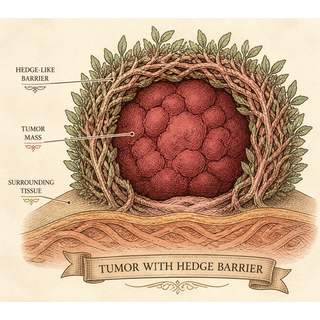
Wang and colleagues describe what they call a blood-brain barrier-like vascular gate, or BVG, in SCLC and other neuroendocrine cancers. This gate is made of unusually tight blood vessels, a thick basement membrane, and heavy pericyte coverage - basically a fortified capillary setup that looks more like the brain's VIP entrance than a typical tumor vessel Wang et al., 2026. The practical effect is simple and grimly elegant: immune cells struggle to enter the tumor.
That matters because immunotherapy cannot do much if the immune system is stuck outside, peering through the window like someone locked out of their own apartment.
A strange little family resemblance
The blood-brain barrier exists for good reasons. Your brain is a fussy organ with strong opinions about who gets in. But seeing a similar structure show up around a tumor is a nasty bit of biological cosplay.
This study suggests SCLC borrows that strategy. The authors found this barrier was distinct from what appears in non-small cell lung cancer and many other tumors. So this is not just "tumors have weird blood vessels," which we already knew. This looks more specific - a neuroendocrine trick that helps explain why SCLC remains such a stubborn customer in the immunotherapy era.
That idea fits with broader work showing that tumor blood vessels do far more than deliver oxygen. They shape who enters, who stays out, and whether the immune system gets any traction at all. Reviews over the last few years have framed tumor vasculature as an active immune regulator, not passive plumbing - which, frankly, is the most on-brand thing in cancer biology, where every structure turns out to have a side hustle (Huang et al., 2025; Georganaki et al., 2024).
The molecular gossip chain
So who tells the vessels to tighten up?
The paper points to ASCL1, a transcription factor that helps define the neuroendocrine identity of SCLC. ASCL1 boosts expression of IGFBP5, which then activates IGF1 signaling in endothelial cells. That signaling helps build and maintain the barrier-like vascular gate Wang et al., 2026.
In plainer language: the tumor's lineage program is not just deciding what kind of cancer cell this is. It is also whispering instructions to nearby blood vessels, telling them to become more exclusive. Not content with being malignant, the tumor also becomes a tiny architect of exclusion.
That is a useful shift in thinking. We often talk about cancer cells and immune cells as if the drama happens only between those two. But the neighborhood matters. Endothelial cells, basement membrane, pericytes - all the supporting cast can decide whether the hero even gets on stage.
Can you pry the gate open?
The encouraging part is that the barrier may be targetable.
In this study, knocking out IGFBP5 or using the IGF1R inhibitor OSI-906 increased CD8 T cell infiltration and improved responses to immunotherapy in preclinical models Wang et al., 2026. That suggests a practical strategy: do not just rev up the immune system - help it physically enter the tumor.
This idea echoes a growing push in oncology to combine immunotherapy with treatments that normalize or remodel the tumor microenvironment. Recent reviews argue that vascular reprogramming may be one of the cleaner ways to improve immune access, especially in "cold" tumors where T cells are scarce to begin with (Fukumura et al., 2025; Hegde and Chen, 2024).
For patients with SCLC, that possibility matters. This cancer is aggressive, fast-moving, and still very hard to treat. Immunotherapy has helped some people, but the gains have been modest. A better explanation for that resistance is not just academically satisfying - it gives researchers a more sensible map.
Why this paper lingers in the mind
There is something almost annoyingly clever about a tumor using a brain-style vascular barrier to protect itself. It is the kind of finding that makes you admire biology while also wanting to file a complaint.
If these results hold up in further studies, they could reshape how we think about neuroendocrine cancers beyond SCLC. Instead of asking only whether immune cells are activated, we may need to ask a more basic question first: can they get past the gate?
Sometimes the biggest problem is not that the body's defenders are weak. Sometimes the door is locked, the curtains are drawn, and the tumor has hired a very competent bouncer.
References
-
Wang Y, Zhong A, Wang B, et al. A blood-brain barrier-like vascular gate limits immunotherapy efficacy in neuroendocrine cancers. Cell. 2026; DOI: 10.1016/j.cell.2026.04.017
-
Huang Y, Goel S, Duda DG, Fukumura D, Jain RK. Cancer blood vessels as immune regulators and therapeutic targets. Nat Rev Cancer. 2025; DOI: 10.1038/s41568-025-00871-z
-
Georganaki M, van Hooren L, Dimberg A. Endothelial cell regulation of anti-tumor immunity. Nat Commun. 2024; DOI: 10.1038/s41467-024-45547-7
-
Fukumura D, Kloepper J, Amoozgar Z, Duda DG, Jain RK. Reprogramming the tumor microenvironment to improve immunotherapy. Nat Rev Clin Oncol. 2025; DOI: 10.1038/s41571-025-00943-2
-
Hegde PS, Chen DS. Getting immune cells into tumors: barriers, bridges, and combination strategies. J Clin Oncol. 2024; PMCID: PMC11327461
Disclaimer: The image accompanying this article is for illustrative purposes only and does not depict actual experimental results, data, or biological mechanisms.