If 1 in 3 people will face cancer in their lifetime, and nearly all of us rack up stress like unread emails, the real math problem is this: what happens when a body already fighting a tumor also gets stuck in permanent fight-or-flight mode? According to a new Cancer Cell paper, the answer may include a bizarre startup nobody asked for - stress, gut microbes, viral DNA, fibroblasts, and B cells teaming up to help tumors scale.
That sounds like cancer biology after three espressos, but stay with me.
Researchers led by Hilal Bashir and colleagues looked at how chronic stress changes anti-tumor immunity. Not in the vague "stress is bad for you" way your smartwatch keeps nagging you about, but in a very specific, mechanistic way. Their claim is sharp: chronic stress can rewire the tumor microenvironment through the gut microbiota, allowing bacterial products - and even phage DNA, meaning DNA from viruses that infect bacteria - to end up inside tumors and weaken the immune response that should be holding cancer back Bashir et al., 2026.
The sketchy group chat inside the tumor
Here is the cast.
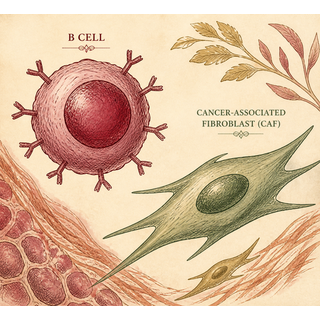
B cells are part of your adaptive immune system. They make antibodies and help organize targeted immune responses. In cancer, they can sometimes support anti-tumor immunity, especially when they form structured immune hubs and help other immune cells recognize what needs destroying.
Cancer-associated fibroblasts, or CAFs, are connective tissue cells that tumors often recruit like shady consultants. They can remodel the tumor neighborhood, shape inflammation, and, depending on the context, make life easier for cancer cells.
Then there are bacteriophages - viruses that infect bacteria. Usually, they are microbiology trivia-night material. In this paper, they show up like an unexpected cofounder on the cap table.
The study found that under chronic stress, mice with colorectal cancer or melanoma had disruption of gut microbial balance and increased movement of Enterococcus gallinarum, a gut pathobiont, into tumors. Once there, DNA from phages associated with that bacterium triggered TLR9 signaling in fibroblasts. TLR9 is an immune sensor that detects certain DNA patterns. Instead of helping kill the tumor, that signal pushed fibroblasts to make glucocorticoids - stress hormones with powerful immune-suppressing effects.
In other words, the tumor seems to outsource part of its security system sabotage. Efficient, terrible, very on-brand.
Stress is not just "in your head"
The key move here is that the researchers connect chronic stress to a physical, trackable circuit:
- Stress alters the gut microbiota
- A bacterium translocates from the gut to the tumor
- Phage DNA activates fibroblasts through TLR9
- Fibroblasts produce glucocorticoids
- Those glucocorticoids suppress antigen-specific germinal center B cell responses through the glucocorticoid receptor
- The tumor grows better because anti-tumor immunity gets throttled
That is a lot more specific than the usual wellness-industrial-complex slogan that stress "lowers immunity." Here, the paper proposes an actual wiring diagram.
And yes, it is weird. A virus that infects a bacterium helps a fibroblast make steroids that shut down B cells inside a tumor? Cancer research truly refuses to be boring.
Why this matters beyond one mouse paper
The obvious caution: much of the mechanistic work was done in mouse models, and mice are helpful but not tiny, unionized humans. Still, the authors did not stop there. They also report lytic phages in a Klebsiella pneumoniae isolate from human colorectal tumors that promoted tumor growth, and they detected phage DNA in human brain tumors. That does not prove the whole circuit works identically in patients, but it raises the stakes considerably.
If these findings hold up, they could reshape how people think about the tumor microenvironment. We usually talk about cancer cells, T cells, macrophages, maybe fibroblasts if we are feeling fancy. This paper argues that microbial passengers and their viruses may also be active operators in the room.
That matters for treatment design. It hints that some tumors may carry hidden biological technical debt: not just mutations, but local microbial and phage ecosystems that quietly sabotage immune responses.
A possible product roadmap, minus the hype goggles
The most actionable part of the study is that the bad circuit was interruptible. Targeting intratumoral TLR9 or reducing E. gallinarum lowered glucocorticoid levels in tumors and reversed the tumor-promoting effects of chronic stress in mice Bashir et al., 2026.
That suggests a few future directions:
- Block the sensing pathway - for example, TLR9-directed strategies in selected tumors
- Target the microbe - if a specific bacterium is helping drive immune suppression
- Rethink stress biology in oncology - not as a vague lifestyle add-on, but as something that may alter treatment response through measurable biology
- Look harder at B cells - which often get less attention than T cells in cancer immunotherapy discourse, despite clearly doing more than sitting quietly in the back row
There is also a broader implication. If gut microbes and phages can influence tumors at distant sites, then cancer therapy may need to think more like systems engineering and less like a one-app fix. The body is not a clean platform. It is legacy infrastructure with weird plugins.
The catch, because there is always a catch
A lot remains unresolved. Which patients carry these microbial circuits? Which tumor types depend on them? Does psychological stress in people produce the same chain of events seen in mice? And can clinicians safely disrupt this pathway without causing collateral damage to helpful immune functions or the broader microbiome?
Those are not minor details. They are the difference between a cool paper and a useful therapy.
Still, this study lands because it takes a fuzzy idea - stress affects cancer - and gives it molecular teeth. It says stress may not merely "influence" the tumor environment. Under the right conditions, it may help build a local suppression network that lets cancer keep shipping product.
That is grim, yes. But it is also useful. Once you can map a circuit, you can try to cut the wire.
References
-
Bashir H, Sanidad KZ, Ravisankar P, et al. Chronic stress unleashes an intratumor phage-fibroblast-B cell circuit to promote tumor growth. Cancer Cell. 2026. DOI: 10.1016/j.ccell.2026.06.004
-
Sepich-Poore GD, Zitvogel L, Straussman R, Hasty J, Wargo JA, Knight R. The microbiome and human cancer. Science. 2021;371(6536):eabc4552. DOI: 10.1126/science.abc4552
-
McCuaig R, Smyth MJ, Miles JJ. How the microbiome shapes cancer immunosurveillance and response to therapy. Trends in Immunology. 2022;43(10):785-798. DOI: 10.1016/j.it.2022.08.002
-
Helmink BA, Khan MAW, Hermann A, Gopalakrishnan V, Wargo JA. The microbiome, cancer, and cancer therapy. Nature Medicine. 2019;25(3):377-388. DOI: 10.1038/s41591-019-0377-7
-
Petitprez F, de Reyniès A, Keung EZ, et al. B cells are associated with survival and immunotherapy response in sarcoma. Nature. 2020;577(7791):556-560. DOI: 10.1038/s41586-019-1906-8
Disclaimer: The image accompanying this article is for illustrative purposes only and does not depict actual experimental results, data, or biological mechanisms.