CAR T cells are already one of oncology’s more theatrical inventions: take a patient’s T cells, give them a custom-built cancer-recognition gadget, grow them in a lab, and send them back in like tiny bodyguards with graduate degrees. It is elegant, expensive, and only slightly less strange than mailing your immune system to engineering school.
The catch? Some CAR T cells stick around for the long haul, patrolling for relapse like serious professionals. Others burn hot, punch hard, and then vanish like interns after lunch. In blood cancers, that difference can matter a lot, because durable remissions often depend on whether enough infused CAR T cells become memory-like cells that can persist and respond again later.
A new Nature Immunology study by Frazee and colleagues asks a beautifully specific question: when a CAR T cell divides for the first time, does the design of its internal “go” button help decide which daughter cell becomes a sprinter and which becomes a marathoner? The answer appears to be yes, because apparently even immune cells have sibling drama Frazee et al., 2026.
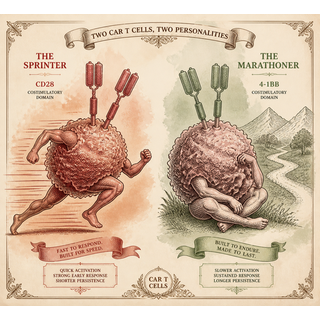
The CAR T Cell Has A Tiny Control Panel
A chimeric antigen receptor, or CAR, is a synthetic receptor that lets a T cell recognize a cancer target without the usual immune-system bureaucracy. Think of it as a barcode scanner bolted onto a security guard.
But the scanner is only part of the machine. Inside the cell, the CAR also contains signaling domains that tell the T cell what mood to be in: attack, grow, survive, calm down, please stop setting off all the alarms. Most FDA-approved CAR T products use one of two costimulatory domains: CD28 or 4-1BB. Both help activate T cells, but they tend to create different personalities. CD28 often pushes fast, intense effector activity. 4-1BB often supports persistence and memory-like features. Same general job, different management style. One is “move fast and break tumors.” The other packed snacks and a five-year plan.
That CD28-versus-4-1BB split has been discussed for years, including in a major review by Cappell and Kochenderfer 2021. What has been less clear is how those signals shape the earliest cell-fate decisions.
One Cell Enters, Two Weirdly Different Cells Leave
Asymmetric cell division is what happens when one cell divides into two daughters that are not identical in destiny. Stem cells do this all the time: one daughter keeps the family business, the other goes off to specialize. Very reasonable. Very cellular.
T cells can do it too. After activation, one daughter can sit closer to the target-facing immune synapse and become more effector-like: energetic, inflammatory, ready to swing a molecular chair. The other daughter can become more memory-like: quieter, metabolically different, and better suited to lasting surveillance. Prior work in Nature showed that this first split can help explain how CAR T cells diversify into short-term fighters and longer-term keepers of the flame Basil et al., 2024.
Frazee and colleagues pushed this idea further by comparing CAR T cells carrying CD28 versus 4-1BB costimulatory domains. They looked across surface proteins, gene expression, chromatin accessibility, metabolism, and long-term behavior. In other words, they did not just ask the cells “how are you feeling?” They checked the diary, bank records, refrigerator contents, and browser history.
The Plot Twist Lives In The Split
The surprising part: CD28 CAR T cells showed more obvious asymmetry at the cell surface after the first division. They had higher CAR surface expression and more surface proteome polarization. On paper, that sounds like a dramatic split.
But inside the daughters, CD28 produced less divergence in transcriptional, epigenetic, and metabolic programs. The daughters looked different on the outside, but their deeper fate programs stayed comparatively muted. Biology, as usual, chose the option most likely to annoy everyone making simple diagrams.
4-1BB CAR T cells did the opposite. They showed less surface polarization, but stronger internal divergence between daughters. One daughter skewed more effector-prone. The other looked more persistence-prone, with memory-like features that could help explain why 4-1BB-based CAR T products often show better durability.
That matters because relapse after CAR T therapy can happen when the cellular army fades, exhausts itself, or fails to maintain enough long-lived surveillance. Reviews of CAR T persistence have repeatedly pointed to memory formation, metabolism, manufacturing conditions, and CAR design as major levers for improving outcomes Liu et al., 2022. This study adds a sharper mechanism: the costimulatory domain may influence fate before the CAR T cell army has even finished its first family meeting.
Why This Could Matter Outside The Lab
If these findings hold up across more CAR designs, targets, diseases, and patient samples, they could help engineers build better cellular therapies. Not just stronger CAR T cells, but better-balanced ones. A therapy may need both the berserker and the librarian: cells that attack immediately and cells that remember where the bodies are buried, immunologically speaking.
This also fits with newer evidence that CD28 and 4-1BB domains drive distinct dysfunctional and metabolic states in CAR T cells Selli et al., 2023; Cook et al., 2025. The future may not be “CD28 good” or “4-1BB good.” That would be far too convenient, and cancer biology has a strict no-convenience policy. Instead, the goal may be tuning the signal so the first few divisions produce the right mix of killers and keepers.
The study does not mean clinicians can pick a CAR T product by peeking at one cell division under a microscope tomorrow. It is mechanistic work, not a magic treatment menu. But it gives researchers a better map of the early decisions that shape persistence, relapse risk, and therapeutic durability.
And honestly, if the fate of a cancer therapy can hinge on how one engineered immune cell divides into two daughters, that is both impressive and rude.
References
-
Frazee CS, Chen S, Berry CT, et al. Fate induction through asymmetric T cell division is modulated by chimeric antigen receptor costimulatory domains. Nature Immunology. 2026. https://doi.org/10.1038/s41590-026-02548-w
-
Basil MC, Frazee CS, O'Connor RS, et al. Fate induction in CD8 CAR T cells through asymmetric cell division. Nature. 2024. https://doi.org/10.1038/s41586-024-07862-7
-
Cappell KM, Kochenderfer JN. A comparison of chimeric antigen receptors containing CD28 versus 4-1BB costimulatory domains. Nature Reviews Clinical Oncology. 2021;18:715-727. https://doi.org/10.1038/s41571-021-00530-z
-
Liu Y, An L, Huang R, et al. Strategies to enhance CAR-T persistence. Biomarker Research. 2022;10:86. https://doi.org/10.1186/s40364-022-00434-9
-
Selli ME, Landmann JH, Terekhova M, et al. Costimulatory domains direct distinct fates of CAR-driven T-cell dysfunction. Blood. 2023;141:3153-3165. https://doi.org/10.1182/blood.2023020100
-
Cook MS, King E, Flaherty KR, et al. CAR-T cells containing CD28 versus 4-1BB co-stimulatory domains show distinct metabolic profiles in patients. Cell Reports. 2025;44:115973. https://doi.org/10.1016/j.celrep.2025.115973
Disclaimer: The image accompanying this article is for illustrative purposes only and does not depict actual experimental results, data, or biological mechanisms.