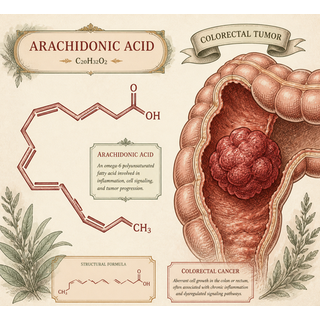
That, in essence, is what this new Gut paper found: colorectal tumors do not just rewire their own fat metabolism like tiny biochemical chaos goblins. They also seem to soak up fats from outside - especially certain long-chain polyunsaturated fatty acids, including arachidonic acid - and stash them inside the tumor tissue. Which is... not ideal, unless you are a tumor and enjoy turning the body into a weird all-you-can-eat buffet.
Wait - tumors can just eat dietary fat?
Apparently, yes. Or at least they can absorb extrinsic lipids, meaning fats that come from outside the tumor rather than being made from scratch inside it.
In this study, Janssen and colleagues analyzed fatty acids in colorectal cancer tissue and matched non-diseased mucosa from a large patient cohort, then validated the finding in a second cohort. They report that extrinsic long-chain PUFAs accumulate in colorectal tumors, with a notable enrichment of arachidonic acid, a fatty acid famous for feeding inflammatory signaling pathways. Right-sided tumors seemed especially prone to this lipid hoarding behavior. The authors also connected the pattern to clinical, genomic, and microbiome data, then backed up key observations in mouse models.1
That matters because arachidonic acid is not just decorative molecular wallpaper. It is the starting material for eicosanoids - signaling molecules like prostaglandins and leukotrienes that can promote inflammation, immune evasion, and tumor growth.23 In other words, the tumor may not merely be collecting fat. It may be stockpiling ingredients for trouble.
The tumor microenvironment: now serving snacks
Cancer metabolism used to get summarized with a kind of macho simplicity: tumors are glucose-hungry monsters. True, but incomplete. Over the last few years, researchers have realized many cancers are also extremely particular about lipids. Fats can be fuel, membrane material, signaling bait, and backup supplies for when the neighborhood gets rough - which, in a tumor, it usually does.
Colorectal cancer sits in a particularly strange zip code for this. It lives in the intestine, surrounded by digested nutrients, microbial metabolites, inflammatory signals, and the microbiome doing whatever the microbiome feels like doing at 3 a.m. with no supervision. So the idea that colon tumors might directly profit from local fat availability is not science fiction. It is more like a very rude use of geography.
Recent reviews have highlighted how lipid metabolism supports cancer cell growth, stress resistance, metastasis, and interactions with immune cells.24 This paper adds a sharper twist: some of those lipids may be imported from the outside world, not only manufactured internally.
Why this is more than a biochemistry fun fact
If this finding holds up and expands, it nudges colorectal cancer toward a more practical and slightly unnerving question: could diet, gut microbes, and tumor metabolism be teaming up more directly than we thought?
Not in the cartoon version where one burger "feeds cancer." Biology is messier than that, and anyone selling absolute dietary certainty in oncology should be handed a mop and a reality check. But this study does suggest that the flux of fatty acids through the gut environment could shape tumor behavior in meaningful ways.
That opens a few interesting doors:
- Therapy targets: If tumors depend on lipid uptake, blocking fatty acid transport or processing might slow growth.45
- Biomarker potential: Lipid signatures could help identify biologically distinct CRC subtypes, especially right-sided tumors.
- Microbiome ties: Gut microbes influence bile acids, inflammation, and lipid availability, so they may affect how hospitable the intestinal "food landscape" is for tumors.6
- Combination strategies: In theory, targeting lipid uptake, inflammatory eicosanoid pathways, and microbiome-related signals together could be more effective than tackling one piece alone.
That last point is where things get spicy - scientifically spicy, not late-night ramen spicy. Arachidonic acid metabolism already overlaps with pathways people care about in cancer, including COX-2/prostaglandin signaling, which has long been implicated in colorectal tumorigenesis.3
The catch, because there is always a catch
Before anybody starts trying to outsmart their colon with a spreadsheet and a bottle of olive oil, a few brakes need pumping.
This study shows association and accumulation, not a finished clinical playbook. We still need to know:
- Which transporters or uptake mechanisms tumors use most
- Whether this lipid uptake directly drives worse outcomes
- How diet changes these tumor lipid pools in actual patients
- Which microbes encourage or block the process
- Whether interfering with lipid flux is safe and effective in humans
Also, tumors are not identical. Right-sided and left-sided colorectal cancers already differ in genetics, biology, and treatment behavior. This paper hints that lipid handling may be part of that split, which makes the story more interesting and, naturally, more annoyingly complicated.
The bigger picture
What I like about this paper is that it makes colorectal cancer feel less like an isolated lump of bad cells and more like what it really is: a system-level hustler. The tumor is not just mutating inward. It is negotiating with its surroundings - nutrients, inflammatory pathways, microbes, maybe even your lunch - and using that whole ecosystem to keep the lights on.
Which is both elegant and a little sinister. Like finding out the villain was not only inside the building but also handling catering.
If future studies confirm this, lipid uptake could become one more weak spot in colorectal cancer's playbook. And in oncology, finding a tumor's supply line is often more useful than staring at its swagger.
References
Disclaimer: The image accompanying this article is for illustrative purposes only and does not depict actual experimental results, data, or biological mechanisms.
-
Janssen KP, Basic M, Bolsega S, et al. Extrinsic lipids are absorbed and accumulate in colorectal cancer. Gut. 2025. doi:10.1136/gutjnl-2025-336377 ↩
-
Koundouros N, Poulogiannis G. Reprogramming of fatty acid metabolism in cancer. Br J Cancer. 2020;122(1):4-22. doi:10.1038/s41416-019-0650-z ↩↩
-
Wang D, Dubois RN. Eicosanoids and cancer. Nat Rev Cancer. 2010;10(3):181-193. doi:10.1038/nrc2809 | PMCID:PMC2811552 ↩↩
-
Broadfield LA, Pane AA, Talebi A, Swinnen JV, Fendt SM. Lipid metabolism in cancer: New perspectives and emerging mechanisms. Dev Cell. 2021;56(10):1363-1393. doi:10.1016/j.devcel.2021.04.013 ↩↩
-
Pascual G, Dominguez D, Benitah SA. The contributions of cancer cell metabolism to metastasis. Dis Model Mech. 2018;11(8):dmm032920. doi:10.1242/dmm.032920 | PMCID:PMC6107941 ↩
-
Janney A, Powrie F, Mann EH. Host-microbiota maladaptation in colorectal cancer. Nature. 2020;585(7826):509-517. doi:10.1038/s41586-020-2729-3 ↩