At halftime, the scoreboard in blood stem cell biology just flipped: the flashy star genes were still on the court, but a little-known long noncoding RNA turned out to be the bench player quietly deciding the game. That is the basic plot of a new Cell paper, and yes, cancer biology has once again revealed that the weirdest person in the room was running operations the whole time.
Researchers studying human genetic variation found a DNA change linked to lower blood counts - but also protection from blood cancers. That alone is enough to make scientists spill coffee on their keyboards. The team traced the effect to a previously unstudied long noncoding RNA, now delightfully named HOTSCRAMBL, sitting in the famous HOXA gene neighborhood. And despite sounding like either a breakfast special or a failed crypto startup, HOTSCRAMBL appears to help human hematopoietic stem cells keep their identity and keep making blood properly.1
Wait - what are we even talking about?
Your blood system runs on hematopoietic stem cells, or HSCs. These are the master cells in bone marrow that can self-renew and spin off all the different blood cell types you need. Red cells, white cells, platelets - the whole factory starts there.
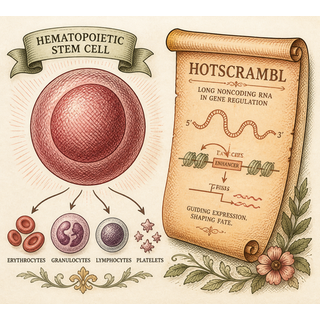
The HOXA genes are part of the instruction manual that helps control development and blood formation. One of them, HOXA9, is especially famous in leukemia research because when it gets misregulated, it can help drive acute myeloid leukemia, or AML.[^2,^3]
Then there are long noncoding RNAs, or lncRNAs. These are RNA molecules that do not make proteins. For years they had a rough reputation as genomic background noise - which, in retrospect, was a little like assuming the person with the clipboard at mission control is just there for vibes. Many lncRNAs help regulate how genes get switched on, how chromatin is organized, or how RNA gets processed.4
This study found one of those backstage operators.
A strange genetic clue with a very interesting side effect
The team started with a human genetic variant called rs17437411 in the HOXA region. People carrying this variant tended to have globally lower blood counts, but they also seemed less likely to develop blood cancers.1
That is a tradeoff worth staring at for a while.
By digging into the region, the researchers identified HOTSCRAMBL, an antisense lncRNA located between HOXA7 and HOXA9. The variant disrupts HOTSCRAMBL's activity. When HOTSCRAMBL is impaired, human blood stem cells lose some of their self-renewal capacity. In startup terms, the stem cell platform stops scaling.
That matters because self-renewal is the core feature that lets HSCs maintain blood production over time. Too little of it, and the system underperforms. Too much of it in the wrong context, especially with cancer-friendly mutations, and you get a cellular company that refuses to stop pivoting into disaster.
HOTSCRAMBL's actual job: keeping HOXA9 on script
Mechanistically, HOTSCRAMBL seems to help maintain proper expression and splicing of HOXA genes - especially HOXA9 - in a way that depends on SRSF2, a known splicing factor.1
That detail is catnip for leukemia researchers because SRSF2 mutations already show up in myeloid malignancies, including clonal hematopoiesis and leukemia.[^5,^6] Splicing, for the uninitiated, is the edit pass on RNA before the cell uses it. If genes are the screenplay, splicing is the final cut. And as anyone who has suffered through a bad sequel knows, editing choices can really wreck the product.
This suggests HOTSCRAMBL is not just hanging around the HOXA locus looking atmospheric. It actively helps blood stem cells produce the right RNA outputs from a gene cluster that has major effects on development and leukemia risk.
Why cancer people should care
The really compelling twist is that HOTSCRAMBL is not only relevant to normal blood stem cells. The study also showed that altering or deleting HOTSCRAMBL compromises HOXA-dependent acute myeloid leukemias.1
That raises an intriguing possibility: some leukemias may depend on this lncRNA-supported regulatory setup to keep their malignant program running. In other words, the tumor's growth stack may include a weird, noncoding RNA layer nobody had fully productized yet.
This fits with a growing body of research showing that leukemia is not driven just by mutant proteins. It also relies on regulatory circuits - chromatin state, RNA processing, enhancer logic, and noncoding transcripts - that act like hidden infrastructure.[^3,^4,^7]
If those dependencies can be targeted, that opens a different therapeutic lane. Not easy. Definitely not next Tuesday. But very interesting.
The catch, because biology always has one
You cannot simply announce "we found a protective variant" and start printing T-shirts.
The same variant linked to lower blood cancer risk also comes with reduced blood counts, which is not exactly a free wellness upgrade.1 Biology rarely offers clean venture-capital exits. More often it offers cursed bundles.
There is also a practical challenge: lncRNAs are notoriously tricky to study and even trickier to target. They often work through structure, location, and interactions rather than tidy enzyme pockets that drug developers can attack. Still, RNA therapeutics are improving fast, and cancer biology has a habit of turning yesterday's "that seems impossible" into tomorrow's Phase 1 trial.
Why this paper feels bigger than one RNA
The broad message here is that human genetics can reveal hidden control layers in cancer and stem cell biology. Instead of starting with a pathway and asking what goes wrong, this study started with naturally occurring human variation and followed the breadcrumb trail to a regulatory RNA with real effects on blood formation and leukemia.
That is smart science and a useful reminder that the genome is less like a simple instruction booklet and more like a giant company org chart where half the most important people have opaque job titles.
And now one of them - HOTSCRAMBL - just got promoted.
References
Disclaimer: The image accompanying this article is for illustrative purposes only and does not depict actual experimental results, data, or biological mechanisms.
-
Lyu P, Agarwal G, Guo CJ, et al. Genetic variation reveals a homeotic long noncoding RNA that modulates human hematopoietic stem cells. Cell. 2026; DOI: 10.1016/j.cell.2026.04.014. PubMed: 42068976 ↩↩↩↩↩
-
Collins CT, Hess JL. Role of HOXA9 in leukemia: dysregulation, cofactors and essential targets. Oncogene. 2016;35(9):1090-1098. DOI: 10.1038/onc.2015.174. PMCID: PMC4763964 ↩
-
Alharbi RA, Pettengell R, Pandha HS, Morgan R. The role of HOX genes in normal hematopoiesis and acute leukemia. Leukemia. 2013;27(5):1000-1008. DOI: 10.1038/leu.2012.356 ↩
-
Statello L, Guo CJ, Chen LL, Huarte M. Gene regulation by long non-coding RNAs and its biological functions. Nat Rev Mol Cell Biol. 2021;22(2):96-118. DOI: 10.1038/s41580-020-00315-9 ↩
-
Inoue D, Bradley RK, Abdel-Wahab O. Spliceosomal gene mutations in myelodysplasia: molecular links to clonal abnormalities of hematopoiesis. Genes Dev. 2016;30(9):989-1001. DOI: 10.1101/gad.278424.116. PMCID: PMC4868011 ↩
-
Yoshimi A, Lin KT, Wiseman DH, et al. Coordinated alterations in RNA splicing and epigenetic regulation drive leukaemogenesis. Nature. 2019;574(7777):273-277. DOI: 10.1038/s41586-019-1611-1 ↩
-
Pisapia P, Feliciello G, Vigliar E, et al. Non-coding RNAs in acute myeloid leukemia: from key drivers to therapeutic vulnerabilities. Cancers (Basel). 2023;15(3):845. DOI: 10.3390/cancers15030845. PMCID: PMC9914861 ↩