A phase II study of vibecotamab found that in a small group of patients with acute myeloid leukemia, myelodysplastic syndromes, or chronic myelomonocytic leukemia, the drug could sometimes wipe out tiny leftover cancer signals or shrink low-blast disease. Not all the time. Not forever. But often enough to make researchers lean forward in their chairs and say, “Hang on, that piece might fit.”
That matters because these diseases are full of awkward middle states. In AML with measurable residual disease, or MRD, a patient can look like they’re in remission, while a microscopic stash of leukemia cells lurks like glitter after a craft project - impossible to ignore and somehow still everywhere. In MDS and CMML after hypomethylating agent failure, the options get thin fast, which is not a phrase anyone wants attached to their treatment plan.
The matchmaker molecule
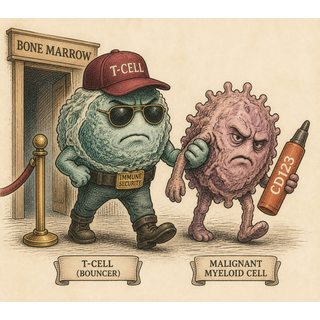
Vibecotamab is a bispecific antibody, which is immunology’s way of building a molecular dating app with very high stakes. One end grabs CD123, a marker found on many malignant myeloid cells. The other grabs CD3 on T-cells, the immune system’s professional bouncers. The goal is simple: force a meeting, let the T-cell notice the bad actor, and then let biology do the rest.
That basic idea has become one of the more interesting patterns in blood cancer treatment. Bispecific antibodies have already made serious waves in lymphoid diseases, and researchers have been trying to see whether the same strategy can work in myeloid cancers, which tend to be more stubborn and less interested in cooperating with our best ideas.
What this study actually found
This was a single-center phase II trial including 48 patients total - 21 with AML-MRD and 27 with MDS/CMML after hypomethylating agent failure Short et al. 2026.
Here’s the scoreboard:
- In the AML-MRD group, 4 of 21 patients cleared MRD - a 19% MRD negativity rate
- In the MDS/CMML group, 18 of 27 patients responded - an overall response rate of 67%
- Median overall survival was 13.1 months for AML-MRD and 6.5 months for MDS/CMML
- The most common side effect was infusion reaction/cytokine release syndrome, seen in 60% of patients, though most cases were grade 1-2
That response rate in the MDS/CMML cohort jumps off the page a bit. The durability, though, is where the confetti cannon gets politely put back in the closet. Responses happened, but they often did not last long. This is less “case closed” and more “we found the suspect, but the plot still has three episodes left.”
Why MRD is such a sneaky problem
MRD is one of cancer medicine’s least flashy but most important clues. If doctors can still detect leukemia cells after treatment, relapse risk usually climbs. So getting rid of MRD is not just cosmetic housekeeping. It can be the difference between a remission that sticks and one that quietly starts unraveling.
That’s why a drug like vibecotamab is intriguing even with a modest 19% MRD clearance rate. In this setting, patients often don’t have many elegant options. A therapy that can push at least some people from “remission, technically” to “remission, and maybe more secure” is worth paying attention to.
The bigger puzzle: CD123 keeps showing up
CD123 has been on researchers’ radar for a while. It appears on many AML and MDS cells, and sometimes on the stem-like cells that may help keep the disease going. That makes it a tempting target, though not a perfect one. Biology, naturally, refuses to be simple.
A recent review of CD123-targeted therapy in AML laid out why the target is attractive but also why success has been uneven - toxicities, antigen variability, and an immune environment that can be about as welcoming as airport security at 5 a.m. (Testa et al., 2024, review). Another review on bispecific antibodies in AML makes the same point from a wider angle: these drugs can work, but myeloid malignancies are not as straightforward as B-cell cancers, and combination strategies may matter a lot (Ruggiero et al., 2024, review).
That last bit is probably the real takeaway here. Vibecotamab alone showed activity. But “activity” is not the same thing as “durable control,” and researchers know it.
Why this could matter in real life
If these results hold up and improve in combination studies, vibecotamab-like drugs could fill a very annoying gap in care. Patients with low-burden myeloid disease often sit in therapeutic limbo - not well served by standard approaches, but not always candidates for something more aggressive. A drug that hunts down residual cells before they become a full relapse would be genuinely useful.
There is also a practical logic here. Lower disease burden may be a sweet spot for immunotherapy. If there are fewer malignant cells to deal with, maybe the T-cells have a better shot at doing their job before the whole neighborhood catches fire. That idea has shown up in broader discussions of immune therapy for myeloid disease too (Bewersdorf and Zeidan, 2023, review).
The catch, because there is always a catch
The trial was small, single-center, and early-phase. That means the signal is interesting, not final. The side effects were mostly manageable, but cytokine release syndrome remains a familiar tax on T-cell-engaging therapies. And the short durability says this approach may need backup - perhaps with hypomethylating agents, venetoclax-based regimens, or other immune strategies.
Which brings us back to the puzzle. This study does not solve AML-MRD or post-HMA MDS/CMML. What it does is show that CD123-directed bispecific therapy can move the disease in the right direction, especially in low-blast settings. That is not the whole picture, but it is a very real corner piece. And corner pieces are how you stop staring at chaos and start seeing the image.
References
-
Short NJ, Bataller A, DiNardo CD, et al. Vibecotamab for measurable residual disease in acute myeloid leukemia and for myelodysplastic syndromes and chronic myelomonocytic leukemia after hypomethylating agent failure: a phase II study. J Hematol Oncol. 2026. doi: 10.1186/s13045-026-01825-3
-
Testa U, Pelosi E, Castelli G. CD123 as a therapeutic target in acute myeloid leukemia and related hematologic malignancies. Cancers (Basel). 2024;16(1):73. doi: 10.3390/cancers16010073
-
Ruggiero E, Raia M, Crimi S, et al. Bispecific antibodies in acute myeloid leukemia: current status and future perspectives. Cancers (Basel). 2024;16(15):2631. doi: 10.3390/cancers16152631
-
Bewersdorf JP, Zeidan AM. Immunotherapy for myelodysplastic syndromes and acute myeloid leukemia: progress and persistent hurdles. Leukemia. 2023;37:1207-1220. doi: 10.1038/s41375-023-01874-6
-
Daver N, Alotaibi AS, Bücklein V, et al. T-cell-based immunotherapy in acute myeloid leukemia. Blood Cancer Discov. 2024;5(1):10-27. doi: 10.1158/2643-3230.BCD-23-0104
Disclaimer: The image accompanying this article is for illustrative purposes only and does not depict actual experimental results, data, or biological mechanisms.