CAR T-cell therapy and a heist movie have more in common than a houseplant and a flamethrower, which is exactly why this paper is so fun: you take a patient’s own T cells, give them a custom disguise-busting gadget, send them back into the body, and hope they can finally spot the lymphoma villain hiding in plain sight. Ten years later, some of those cellular agents are still apparently clocking in. Which, in cancer medicine, is the kind of plot twist that makes immunology nerds start waving their arms around in public.
A new New England Journal of Medicine report followed 38 people with heavily pretreated B-cell non-Hodgkin lymphomas who received an early anti-CD19 CAR T-cell therapy called CTL019, now known as tisagenlecleucel. The headline is simple and pretty wild: some patients had remissions that lasted a full decade, and no relapses happened beyond 5.4 years after treatment.1
The immune-system spy thriller
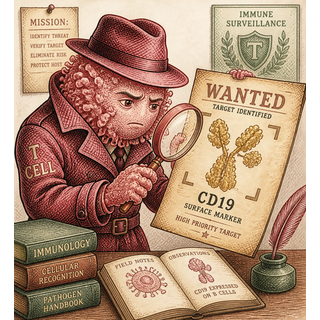
Quick translation. T cells are your immune system’s elite field agents. Usually, they patrol for suspicious activity, but cancer cells are sneaky little crooks. B-cell lymphomas grow from B cells, and many of them carry a marker called CD19 on their surface. CAR T-cell therapy takes a patient’s T cells, engineers them to recognize CD19, then sends them back in with what is basically a molecular wanted poster taped to their forehead.
That matters because patients in this study had relapsed or refractory disease - meaning standard treatments had already tried, and often failed, to shut the whole thing down. These are not easy cases. This is the cancer equivalent of calling in the weird specialist from season 5 because everyone else has already had their turn.
What the study actually found
The study included 24 patients with large B-cell lymphoma and 14 with follicular lymphoma. Median follow-up was 10.1 years, which is an eternity in CAR T follow-up terms. Here’s the part that jumps off the page:
- In large B-cell lymphoma, 10-year lymphoma-free survival was 32%
- In follicular lymphoma, 10-year lymphoma-free survival was 47%1
That does not mean CAR T works for everyone. It clearly does not. But for a meaningful fraction of these patients, one infusion led to remissions that lasted long enough to make the word “curative” feel less like science-fiction optimism and more like a serious question.
The other eyebrow-raiser: no relapses occurred beyond 5.4 years. That suggests that if a patient stays in remission for long enough, the odds start looking very different. In plain English, the longer the getaway car keeps driving, the less likely the villain is about to leap out of the trunk.
Why this is a big deal, even if you hate hype
Cancer research loves a dramatic headline and then immediately asks everyone to calm down. Fair enough. But this paper earns attention because long-term durability is the whole ballgame. Early responses are nice. Shrinking scans are nice. A remission that is still there ten years later? That is the kind of result patients actually build a life around.
CAR T has already changed treatment for several blood cancers, especially diffuse large B-cell lymphoma, mantle cell lymphoma, acute lymphoblastic leukemia, and multiple myeloma through related designs.23 But one of the biggest open questions has been whether CAR T is a bridge, a stall tactic, or a true long-haul fix for some patients. This report says: for some people, it may be the real deal.
And because I am incapable of not cheering for T cells, I must point out another intriguing detail: patients with longer-lasting remissions seemed to have greater persistence of the CAR transgene.1 Translation: the engineered T cells may need to stick around like stubborn private investigators who refuse to leave the case.
The catch, because biology never lets us have one clean victory
This is not a fairy tale where the immune system kicks in the door and everybody goes home by intermission. The study is small - just 38 patients - and it reflects an early CAR T product and an early-treatment-era population. That means we should be careful about overgeneralizing.
There were also long-term risks. Persistent neutropenia showed up in a small number of patients, and second primary cancers developed in 9 patients, with a 10-year cumulative incidence of 21%.1 That does not mean CAR T caused every one of those cancers - these patients had already received lots of prior therapy, which muddies the waters considerably - but it does remind us that long survivorship needs long surveillance. You do not win the spy thriller and then stop checking whether someone bugged the apartment.
There are also access issues. CAR T is logistically complicated, expensive, and available mainly at specialized centers. Manufacturing can take time. Some patients are too sick to wait. Others relapse after treatment. Researchers are now trying to improve persistence, reduce toxic effects, and build faster or off-the-shelf versions.45
Where this could go next
The most exciting part may be what this means for the future design of CAR T therapy. If persistence really helps lock in long-term control, then engineers can treat that like a clue, not a mystery. Better cell fitness, smarter receptor design, and improved manufacturing might push more patients into that long-remission zone.
And yes, the immune system remains gloriously weird. In some long-term responders, B-cell aplasia persisted for years.1 That sounds alarming, but it also acts like a sign the CAR T cells may still be active, continuing to eliminate normal CD19-positive B cells along with any dangerous ones that try to sneak back. Helpful? Yes. Elegant? Sort of. Inconvenient? Also yes. Biology contains multitudes.
The big takeaway is not that CAR T has solved lymphoma. It has not. The takeaway is that a single infusion of engineered immune cells produced decade-long remissions in a subset of patients who had already run low on options. That is not hype. That is a genuine shift in what “possible” looks like.
References
Disclaimer: The image accompanying this article is for illustrative purposes only and does not depict actual experimental results, data, or biological mechanisms.
-
Ruella M, Paruzzo L, Chong ER, et al. Ten-Year Outcomes after CAR T-Cell Therapy for B-Cell Lymphomas. N Engl J Med. 2025. doi:10.1056/NEJMoa2518035 ↩↩↩↩↩
-
Neelapu SS, Locke FL, Bartlett NL, et al. Axicabtagene Ciloleucel CAR T-Cell Therapy in Refractory Large B-Cell Lymphoma. N Engl J Med. 2017;377(26):2531-2544. doi:10.1056/NEJMoa1707447 ↩
-
Sadelain M, Riviere I, Riddell S. Therapeutic T cell engineering. Nature. 2017;545(7655):423-431. doi:10.1038/nature22395 ↩
-
Wang M, Munoz J, Goy A, et al. KTE-X19 CAR T-Cell Therapy in Relapsed or Refractory Mantle-Cell Lymphoma. N Engl J Med. 2020;382(14):1331-1342. doi:10.1056/NEJMoa1914347 ↩
-
Sterner RC, Sterner RM. CAR-T cell therapy: current limitations and potential strategies. Blood Cancer J. 2021;11(4):69. doi:10.1038/s41408-021-00459-7 | PMCID:PMC8065158 ↩