A good gardener knows that not all cutting is the same. Snip one stem and the bed scarcely notices; strike the right weed at the root and the whole patch changes its mood. Cancer therapy faces much the same problem - not merely killing bad cells, but doing it in a way that rouses the rest of the body to join the cleanup rather than yawn and carry on.
That is the clever bit in a new paper from Advanced Materials, where researchers compared two flavors of photodynamic therapy - a treatment that uses light to activate special molecules called photosensitizers, which then generate toxic chemical species inside tumors.1 The broad question sounds technical, and it is, but the practical version is pleasantly straightforward: if you are going to blast a tumor with light-triggered chemistry, which version makes the immune system sit up in its chair?
Light, Chemistry, and a Very Bad Day for a Tumor
Photodynamic therapy, or PDT, works a bit like installing faulty wiring in a condemned building and then flipping the switch. A photosensitizer accumulates in tumor tissue. Light hits it. Reactive molecules form. Cells suffer. Ideally, tumors crumble while healthy tissue avoids most of the fuss.
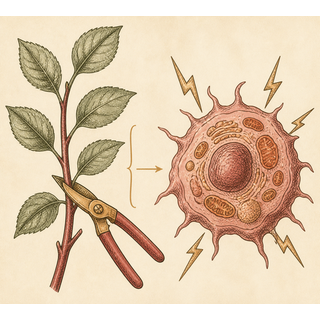
But tumors are crafty bits of unauthorized construction. Simply damaging them is not always enough. What oncologists increasingly want is immunogenic cell death - cancer cells dying in such a noisy, inflammatory manner that the immune system notices the wreckage and starts hunting elsewhere too.[^2,^3]
This new study asks whether two different photodynamic routes - called type I and type II - produce equally useful chaos. They do not, apparently.
Two Kinds of Cellular Arson
Type II PDT mainly generates singlet oxygen, a reactive form of oxygen that has long been the classic star of photodynamic therapy.4 Type I PDT, by contrast, leans more on electron transfer reactions and produces other reactive oxygen species such as superoxide and hydroxyl radicals. If that sounds like chemistry trying too hard at a dinner party, fair enough. The biological point is simpler: these routes stress cells differently, and cells can die differently in response.
The authors designed a series of organic photosensitizers with a donor-acceptor-donor architecture tuned to favor either type I or type II photodynamics. That rational design phrase can sound like grant-writing upholstery, but here it really matters. They adjusted the molecules so they could compare the two mechanisms more cleanly, rather than tossing in unrelated compounds and hoping for philosophical clarity.
And then came the interesting part.
Pyroptosis: Not Just Death, but a Fire Alarm
The type I-dominant photosensitizers outperformed the type II-dominant ones at triggering pyroptosis.1 Pyroptosis is a highly inflammatory form of cell death - less quiet demolition, more burst pipe with alarms blaring and neighbors calling the authorities.5 It often involves caspase-1 activation, membrane rupture, and release of molecular distress signals.
That matters because dead tumor cells can be oddly polite. Many forms of cell death leave behind debris without much public commotion. Pyroptosis, however, spills out damage-associated molecular patterns and inflammatory factors that help recruit and activate immune cells. In architectural terms, it is the difference between a wall being removed behind closed doors and a staircase collapsing into the street with enough racket to summon the entire inspection department.
In this paper, the type I photosensitizer pushed tumor cells toward caspase-1-mediated pyroptosis, and that translated into stronger immune activation. In mice, the lead compound also did a better job suppressing distant tumors after local light treatment. That is the dream of photoimmunotherapy - you treat one site, and the immune system starts patrolling the rest of the estate rather than standing around like a security guard studying his shoes.
Why This Is More Than Fancy Molecular Carpentry
Cancer researchers have spent years trying to make local therapies produce systemic immune effects. Surgery removes. Radiation damages. PDT burns with elegance. Yet metastatic disease laughs at local elegance if the immune system does not join in.
This study suggests that the exact chemistry of the photosensitizer can shape how loudly dying tumor cells announce themselves. That is important because PDT has sometimes been limited by oxygen dependence, uneven tissue penetration, and variability in immune response.[^4,^6] Type I photochemistry may offer advantages in harsher tumor environments where oxygen is scarce - tumors being, as ever, shoddy developments with poor infrastructure.
If these findings hold up, clinicians may someday choose or design photosensitizers not simply by how efficiently they kill cells under light, but by what kind of immunologic scene they leave behind. One can almost hear the pathologist in the back muttering, at last, a demolition plan with some attention to the neighborhood.
The Catch, Because There Is Always One
Before we declare victory and hand the tumor a tiny eviction notice, a few cautions. This is preclinical work. Mouse immune systems are useful, but they are not just small, whiskered people with unfortunate housing. Human tumors are more heterogeneous, more evasive, and much better at paperwork.
There are also practical questions: how broadly does this apply across cancer types, what are the safety margins, how well do these compounds distribute in real tumors, and how will they combine with checkpoint inhibitors or other immunotherapies?[^^2,^7] Those are not minor details. They are the load-bearing beams.
Still, the central message is sturdy. In photoimmunotherapy, the manner of cellular death is not a decorative flourish. It is part of the treatment design itself.
References
Disclaimer: The image accompanying this article is for illustrative purposes only and does not depict actual experimental results, data, or biological mechanisms.
-
Huang J, Wang Z, Li H, et al. Utilizing Rationally Designed Photosensitizers to Drive Divergent Immunogenic Cell Death in Photoimmunotherapy. Adv Mater. 2025. doi:10.1002/adma.202522822 ↩↩
-
Galluzzi L, Humeau J, Buqué A, Zitvogel L, Kroemer G. Immunostimulation with chemotherapy in the era of immune checkpoint inhibitors. Nat Rev Clin Oncol. 2020;17(12):725-741. doi:10.1038/s41571-020-0413-z ↩
-
Fucikova J, Kepp O, Kasikova L, et al. Detection of immunogenic cell death and its relevance for cancer therapy. Cell Death Dis. 2020;11:1013. doi:10.1038/s41419-020-03221-2 PMCID: PMC7701612 ↩
-
van Straten D, Mashayekhi V, de Bruijn HS, Oliveira S, Robinson DJ. Oncologic photodynamic therapy: basic principles, current clinical status and future directions. Cancers (Basel). 2021;13(11):2737. doi:10.3390/cancers13112737 PMCID: PMC8198698 ↩
-
Xia X, Wang X, Cheng Z, et al. The role of pyroptosis in cancer: pro-cancer or pro-"host"? Cell Death Dis. 2019;10:650. doi:10.1038/s41419-019-1883-8 PMCID: PMC6711556 ↩
-
Li X, Lovell JF, Yoon J, Chen X. Clinical development and potential of photothermal and photodynamic therapies for cancer. Nat Rev Clin Oncol. 2020;17(11):657-674. doi:10.1038/s41571-020-0410-2 ↩
-
Wang M, Yin B, Wang HY, Wang RF. Current advances in T-cell-based cancer immunotherapy. Immunotherapy. 2021;13(6):429-445. doi:10.2217/imt-2020-0241 ↩