That sounds nice if you're planning a picnic. It is less nice if you're trying to get your immune system into a small-cell lung cancer tumor, where some blood vessels appear to be doing the biological equivalent of running a velvet-rope nightclub with a very aggressive bouncer list. A recent Cell paper highlighted in a commentary by Trotta, Ma, and Mazzone argues something genuinely counterintuitive: in some tumors, blood vessels can be too intact, and that very neatness helps keep anti-cancer immune cells out.[1]
For years, cancer researchers have talked about "normalizing" tumor blood vessels. Tumor vessels are usually chaotic - leaky, twisted, badly organized, like a city planned by raccoons. Fixing them can improve drug delivery and sometimes help immune cells get in. But this new work points to a plot twist worthy of the season finale nobody saw coming: in small-cell lung cancer, excessive vascular integrity may create an "immune-excluding" setup that turns the tumor into a cellular gated community.
When the roads are too smooth, the cops miss the raid
Your immune system does not fight cancer by vibes alone. Immune cells need access. They travel through blood vessels, exit into tissue, and then go hunting for suspicious cells. If tumor blood vessels are dysfunctional, that's bad. If they're so sealed up that immune cells cannot squeeze through, that can also be bad. Biology, as usual, refuses to keep things simple for our convenience.
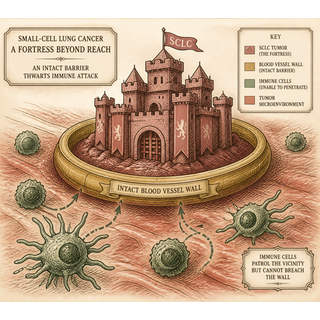
The idea highlighted here is called reverse normalization. Instead of making vessels even tidier, the goal would be to loosen this overly strict vascular barrier just enough to let immune cells enter the tumor. Not enough to create chaos - more like replacing a biometric vault door with a normal office badge reader. You still want order. You just do not want the T cells locked in the parking lot.
This matters a lot for small-cell lung cancer, one of the nastier lung cancers and one that often responds poorly over time, including to immunotherapy.[2] If immune cells cannot physically get inside the tumor, then checkpoint inhibitors can end up feeling a bit like giving your best action hero a pep talk while trapping them outside the building.
The tumor microenvironment: less "open office," more "Succession"
Cancer is not just a lump of rogue cells. It is a whole ecosystem - tumor cells, blood vessels, fibroblasts, immune cells, signaling molecules, metabolic weirdness, the works. Researchers call this the tumor microenvironment, which is a polite scientific term for "a deeply dysfunctional neighborhood with terrible leadership."
A growing body of research shows that blood vessels do more than deliver oxygen and nutrients. They help shape who gets into the tumor and who stays out.[3,4] Endothelial cells - the cells lining blood vessels - can act like border control. In some cancers, they become permissive and messy. In others, they may form a barrier that contributes to an "immune desert," meaning there are very few tumor-fighting T cells present.[5]
That distinction matters because many modern cancer therapies, especially immunotherapies, work best when T cells can actually reach their target. Shocking, I know.
Why this paper is such a fun little troublemaker
The intriguing part is not just the biology. It is that this work pokes at a cherished idea and says, gently but firmly, "Maybe not always."
Vessel normalization has been a major concept in oncology for years, especially after work showing that correcting abnormal vessels can improve treatment response.[3] But tumors are not all reading the same script. In small-cell lung cancer, Wang and colleagues appear to have found a vascular state where too much integrity supports immune desertification - basically the tumor equivalent of a luxury bunker with no guest list for lymphocytes.
If that finding holds up across more studies, it could help explain why some tumors resist immunotherapy even when the immune system is not entirely asleep. The problem may be less "the soldiers are weak" and more "the drawbridge never comes down."
What this could mean in the real world
If reverse normalization proves reproducible, it could open a new therapeutic angle: modulating tumor vessels to improve immune entry, then pairing that with immunotherapy. That is especially appealing in cancers like small-cell lung cancer, where treatment options remain limited and relapse is common.[2]
In practical terms, future treatment might involve asking a much more precise question than "Should we normalize vessels?" Instead: What kind of vessel state does this particular tumor have, and how do we tune it so immune cells can get in without causing harmful chaos?
That is a very 2026 oncology sentence, but it points toward something real - smarter, context-specific treatment rather than one-size-fits-all vascular landscaping.
Of course, there are challenges. Tumor blood vessels are heterogeneous. What helps one cancer type may backfire in another. Opening vessels too much could worsen edema, metastasis risk, or drug distribution problems. And a commentary is not the same thing as a finished clinical playbook. We are still in the "interesting map" stage, not the "Google Maps with turn-by-turn directions" stage.
Still, this is the kind of paper that makes cancer biology feel gloriously, annoyingly alive. Just when you think you have the trope figured out, the blood vessels pull a Severance and reveal they have been running a second plotline the whole time.
References
-
Trotta R, Ma L, Mazzone M. Excessive vascular integrity restricts anti-tumor immunity. Cell. 2026; DOI: 10.1016/j.cell.2026.05.034. PubMed: 42349379
-
Rudin CM, Brambilla E, Faivre-Finn C, Sage J. Small-cell lung cancer. Nat Rev Dis Primers. 2021;7(1):3. DOI: 10.1038/s41572-020-00235-0.
-
Huang Y, Goel S, Duda DG, Fukumura D, Jain RK. Vascular normalization as an emerging strategy to enhance cancer immunotherapy. Cancer Res. 2013;73(10):2943-2948. DOI: 10.1158/0008-5472.CAN-12-4354. PMCID: PMC3688369
-
Mazzone M, De Palma M. The normalization of tumor blood vessels: a new therapeutic target? Nat Rev Drug Discov. 2010;9(10):719-731. DOI: 10.1038/nrd3273.
-
Hegde PS, Chen DS. Top 10 challenges in cancer immunotherapy. Immunity. 2020;52(1):17-35. DOI: 10.1016/j.immuni.2019.12.011.
Disclaimer: The image accompanying this article is for illustrative purposes only and does not depict actual experimental results, data, or biological mechanisms.