Cancer loves categories. Patients, meanwhile, keep showing up with biology that ignores the filing system. This new international registry study looks at systemic mastocytosis with an associated myeloid neoplasm - usually shortened to SM-AHN - a diagnosis that sounds like somebody dropped Scrabble tiles on a hematology textbook, but it marks a very real and very rough clinical situation.1
Systemic mastocytosis, or SM, is a disease where mast cells build up in organs outside the skin. Mast cells are immune cells best known for stirring up allergies - histamine, itching, swelling, all the greatest hits. Usually they are useful little sentries. In SM, they go off-script, multiply, and start colonizing the bone marrow and other tissues like tenants who have decided rent is now optional.2
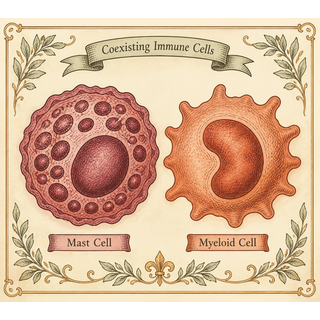
Now add a second problem: a myeloid neoplasm, meaning another blood cancer arising from the marrow's blood-forming machinery. In many SM-AHN cases, the two diseases are not random roommates. They often come from a shared clone - the same bad ancestral cell with a terrible life plan.3
The registry report from the front
The new paper pulled data from the European Competence Network on Mastocytosis registry, covering 3,925 patients with SM. Of those, 467 patients - about 12% - had SM-AHN involving a myeloid neoplasm.1 That makes this one of the biggest looks yet at a condition most doctors will rarely see.
A few patterns jump out fast.
Patients with SM-AHN were older, more often male, and less likely to have skin involvement than patients with SM alone.1 The associated myeloid cancers were not all the same, but the most common group was myelodysplastic/myeloproliferative neoplasms, especially chronic myelomonocytic leukemia, which showed up like the usual suspect in a police lineup.1
And then comes the part that lands with a thud: survival was dramatically shorter in SM-AHN than in SM without an associated blood cancer. Median overall survival was 36.1 months for SM-AHN versus 340.9 months for SM without AHN.1 That is not a rounding error. That is the difference between a storm warning and the storm already tearing shingles off the roof.
The mast cell side matters more than people may have hoped
Here is the twist in the trench report: within SM-AHN, outcomes were driven strongly by how aggressive the mastocytosis itself was.
Patients with advanced SM-AHN - meaning aggressive systemic mastocytosis or mast cell leukemia on the mast cell side - did much worse than those with non-advanced SM-AHN. Median overall survival was 28.3 months versus 70.9 months.1 In multivariable analysis, having non-advanced SM remained independently linked to better survival.1
That matters because, when a patient has two blood cancers at once, there is a temptation to focus on the louder, more familiar myeloid one and treat the mast cell disease like background noise. This paper argues that the mast cell component is not background noise. It is very much in the band, and sometimes it is the drummer trying to fight everyone in the parking lot.
The AHN subtype still mattered too. Patients with SM associated with acute myeloid leukemia had the worst median survival at 14.7 months. Those with SM-MPN did better, at 57 months.1 But the broad message holds: if the SM component is advanced, the outlook gets darker fast.
Why this changes the conversation
This study does not hand us a magic cure. It does something more basic and more useful - it sharpens the map.
SM-AHN is rare and messy. Rare diseases often suffer from a special kind of medical chaos: not enough cases, too many classification updates, and just enough uncertainty to make every treatment decision feel like assembling IKEA furniture during an earthquake. This registry analysis helps sort out which features actually track with survival in the modern classification era.1
That has practical consequences. KIT D816V mutations are common in advanced SM, and KIT-targeted tyrosine kinase inhibitors such as avapritinib and midostaurin have changed treatment options for many patients with advanced disease.45 If the aggressiveness of the mastocytosis component strongly shapes outcomes, then spotting and classifying that component correctly is not academic fussiness. It can guide therapy.
The bigger backdrop
Recent reviews have emphasized that advanced SM and SM-AHN sit at the crossroads of mast cell biology, clonal hematopoiesis, and precision oncology.236 The disease is not just "allergies gone rogue." It is a marrow-level problem with genetic architecture, prognostic layering, and treatment implications that now include targeted drugs.
Still, plenty of problems remain. Registry studies are powerful, but they are not randomized trials. Real-world cohorts can be uneven. Treatment histories vary. Molecular data are not always complete. And rare diseases have a nasty habit of refusing to fit neatly into even our best statistical boxes.
But this paper gives clinicians a clearer warning flare: in patients with both systemic mastocytosis and a myeloid neoplasm, do not underestimate the mast cell disease. Count it. Classify it. Treat it like it matters, because it does.
That may sound obvious. In cancer medicine, obvious usually means "we learned it the hard way."
References
Disclaimer: The image accompanying this article is for illustrative purposes only and does not depict actual experimental results, data, or biological mechanisms.
-
Hermine O, Debeaupuis O, Damaj G, et al. Outcomes and prognostic factors in patients with systemic mastocytosis and an associated myeloid neoplasm: an international ECNM registry study. J Hematol Oncol. 2026;19:??. doi:10.1186/s13045-026-01819-1. PubMed: 42363232 ↩↩↩↩↩↩↩↩↩
-
Valent P, Akin C, Hartmann K, et al. Updated diagnostic criteria and classification of mast cell disorders: a consensus proposal. Hematol Oncol Clin North Am. 2022;36(3):??-??. Related background on systemic mastocytosis and mast cell disease. See also Wikipedia overview: Systemic mastocytosis ↩↩
-
Jawhar M, Schwaab J, Gotlib J, et al. The clinical and molecular diversity of advanced systemic mastocytosis and SM-AHN. Leukemia. 2023;37:??-??. Review of clonal architecture and associated hematologic neoplasms. ↩↩
-
Gotlib J, Reiter A, Radia DH, et al. Efficacy and safety of avapritinib in advanced systemic mastocytosis. Nat Med. 2021;27:2183-2191. doi:10.1038/s41591-021-01538-9 ↩
-
Gotlib J, Kluin-Nelemans HC, George TI, et al. Efficacy and safety of midostaurin in advanced systemic mastocytosis. N Engl J Med. 2016;374:2530-2541. doi:10.1056/NEJMoa1513098 ↩
-
Schwaab J, Naumann N, Luebke J, et al. Risk stratification and treatment in advanced systemic mastocytosis. Blood. 2024;143(??):??-??. Recent review discussing prognosis, KIT-targeted therapy, and SM-AHN management. ↩