Inside your gut, cells run on a production line so absurdly efficient it would make a German car plant blush: stem-like cells start in the crypts, move upward, swap toolkits, and graduate into specialized workers. This paper argues that a big part of that factory discipline comes from genomic control rooms called super-enhancers - and when key foremen vanish, the whole place starts producing trouble instead of tissue.
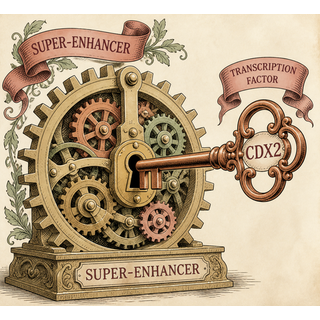
A team led by Fang and colleagues mapped these super-enhancers across the small intestine and then tracked what happens during normal differentiation and during colorectal cancer-like change. The short version? Certain transcription factors - especially CDX2, HNF4, and SMAD4 - don’t just hang around the genome looking important. They help organize the regulatory command centers that keep intestinal cells acting like intestinal cells instead of freelancing into chaos.
Super-enhancers: not regular enhancers with a gym membership
Let’s translate the jargon before cancer biology tries to bench-press your patience.
Genes are not just turned on by a lonely switch. They’re controlled by regulatory DNA regions called enhancers, where proteins land to boost gene activity. Super-enhancers are oversized clusters of these regions - dense neighborhoods packed with transcription factors and co-factors that drive the genes most tied to cell identity. If ordinary enhancers are light switches, super-enhancers are the operations room with ten blinking monitors and one stressed manager holding coffee.
That matters in the intestine because the intestinal lining constantly renews itself. Cells are born in the crypts, mature as they climb toward the villi, and change their gene expression along the way. This study asked a simple but sneaky question: which super-enhancers control that journey, and what happens when the system gets hijacked during cancer?
A map of the gut’s command posts
The researchers built a spatiotemporal map of super-enhancers in the mouse small intestine. They found that super-enhancers differ by location and cell state. Some are tied to the crypt, where cells are more proliferative and stem-like. Others belong to the villus, where cells are more differentiated and focused on actual digestive labor instead of endless division.
That might sound tidy, but it’s a big deal. It means the intestine doesn’t just use different genes in different places - it uses different regulatory architecture. The command posts themselves are compartment-specific.
And then came the tactical question: who’s running these command posts?
The answer pointed to CDX2, HNF4, and SMAD4, which act like senior officers in the intestinal chain of command. These transcription factors help maintain the enhancer landscape that supports epithelial identity and differentiation. In plainer language, they keep gut cells on mission.
CDX2: the foreman who keeps the assembly line from eating itself
Among the three, CDX2 came off looking especially central. When the researchers knocked it out in mouse models, super-enhancers broadly collapsed. Not “became slightly untidy.” Collapsed. Along with them went expression of genes needed for intestinal identity.
That’s the kind of result that makes molecular biologists sit up a little straighter in their swivel chairs. CDX2 wasn’t merely one more cog in the machine. It looked more like the person with the factory keys.
The idea here is bigger than one protein. It suggests that cell identity is not maintained gene by gene in isolation, but by a network of powerful regulatory hubs. Remove a master organizer, and the chromatin landscape itself starts losing structure. The genome, apparently, also has days when it needs adult supervision.
Cancer rewires the board
The paper gets even more interesting when it moves from normal differentiation to oncogenesis.
In colorectal cancer-related settings, the super-enhancer landscape gets remodeled. That means tumors are not just mutating genes or turning pathways up and down. They may be rewiring the regulatory circuitry that determines which genes get premium expression in the first place.
Here, HNF4 and SMAD4 appeared to act as super-enhancer-associated tumor suppressors. They help restrain oncogenic enhancer programs - basically stopping the wrong genomic districts from becoming VIP lounges for cancer-promoting genes.
That’s a sharp way to think about tumor progression. Cancer is not just a pile of bad mutations. It’s also a strategic coup, where the wrong command centers get fortified and the old defense ministers get shoved out a side door.
Why this matters outside the mouse cage
If these findings hold up and extend into human disease, they could help explain how intestinal cells lose their normal identity during colorectal cancer development. That has obvious implications for biomarkers, risk stratification, and maybe one day even therapies that target regulatory networks rather than single genes.
That last point is the chess move. Cancer often dodges direct attacks. Block one pathway, and it wriggles into another like a cell with a backup passport. But if you understand the enhancer circuitry that supports whole gene programs, you may get a shot at the tumor’s broader strategy, not just one pawn.
There are caveats, of course. This study leans heavily on mouse models, and enhancer biology is complicated enough to make anyone question their career choices before lunch. Super-enhancers are also slippery therapeutic targets. You can’t just march in with a wrench and fix “genomic regulation” by Tuesday. Still, this work gives a clearer blueprint of the battlefield.
And that’s the hook: the intestine isn’t maintained by a random blur of genes flipping on and off. It’s governed by organized regulatory strongholds, staffed by master transcription factors, and vulnerable to takeover when those leaders fall. Cancer, in this framing, looks less like simple disorder and more like hostile corporate restructuring.
References
-
Fang W, Huang S, Xiao R, et al. Dynamics and master transcription factors dependence of intestinal super-enhancers during differentiation and oncogenesis. Nucleic Acids Res. 2023;51(16):8501-8521. doi:10.1093/nar/gkad634
-
Hnisz D, Abraham BJ, Lee TI, et al. Super-enhancers in the control of cell identity and disease. Cell. 2013;155(4):934-947. doi:10.1016/j.cell.2013.09.053 PMCID:PMC3841062
-
Whyte WA, Orlando DA, Hnisz D, et al. Master transcription factors and mediator establish super-enhancers at key cell identity genes. Cell. 2013;153(2):307-319. doi:10.1016/j.cell.2013.03.035 PMCID:PMC3653129
-
Sugimoto S, Fujii M, Matano M, et al. Modeling colorectal cancer using CRISPR-Cas9-mediated engineering of human intestinal organoids. Nat Med. 2017;23(2):256-262. doi:10.1038/nm.4232
-
Dekker E, Tanis PJ, Vleugels JLA, Kasi PM, Wallace MB. Colorectal cancer. Lancet. 2019;394(10207):1467-1480. doi:10.1016/S0140-6736(19)32319-0
Disclaimer: The image accompanying this article is for illustrative purposes only and does not depict actual experimental results, data, or biological mechanisms.