One drug, two targets, and a very ambitious résumé
Advanced squamous non-small-cell lung cancer is one of those diagnoses that forces medicine to stop being polite and start being effective. This subtype of lung cancer can be aggressive, hard to treat, and not exactly generous with second chances. Standard first-line treatment has improved with immunotherapy plus chemotherapy, but the survival bar is still not where anyone would like it to be.
That is where ivonescimab enters the chat.
This Lancet commentary by Tina Cascone and Giannis Mountzios discusses whether ivonescimab might push outcomes higher in advanced squamous non-small-cell lung cancer.1 Basically, ivonescimab is designed to hit two important cancer-related pathways at once: PD-1 and VEGF.
In other words, it is trying to both:
- remove one of the brakes that keeps immune cells from attacking the tumor, and
- disrupt the blood-vessel support system tumors use like greedy little landlords collecting oxygen rent.
That combination idea is not random. It comes from a growing pile of evidence suggesting that immune suppression and abnormal tumor blood vessels work together like annoying coworkers who make every project worse.
Why these two pathways matter
Let’s translate the biology into normal-person language.
PD-1 is part of an immune checkpoint system. Normally, this helps prevent your immune system from attacking the wrong targets. Very useful when things are working properly. Less useful when cancer cells hijack it and basically flash a fake employee badge that says, “No worries, I belong here.”
Drugs that block PD-1 can help T cells recognize and attack cancer. They have already changed the treatment landscape in lung cancer.
VEGF, meanwhile, helps tumors build and maintain blood vessels. That sounds boring until you remember that tumors need nutrients and oxygen, and blood vessels are how they get Uber Eats. VEGF also contributes to a tumor environment that can be hostile to immune-cell entry. So even if you have motivated T cells, they may still feel like the security team locked outside the building.
A drug that tackles both could, in theory, make tumors more vulnerable from two directions at once.
Why this is getting attention now
This commentary asks a simple but loaded question: can we raise the survival bar? That phrase matters. In lung cancer, doctors are not just looking for small statistical wiggles that make conference slides happy. They want longer survival, more durable responses, and treatment strategies that actually change what happens to real people sitting in real infusion chairs on a Wednesday morning.
The broader idea behind ivonescimab fits with a major trend in oncology: dual-purpose therapies that try to reshape the tumor microenvironment while also revving up immunity.
And there is logic behind that trend. Prior research has shown that VEGF signaling does more than feed tumors - it can also interfere with antitumor immunity, making immune checkpoint therapy less effective.23 That is why combining anti-angiogenic approaches with immunotherapy has become such a hot area in thoracic oncology. Not “hot” in the fun summer sense. More in the “scientists keep making increasingly complicated pathway diagrams” sense.
The big promise - and the very reasonable caution
If ivonescimab really improves outcomes in advanced squamous NSCLC, the real-world implications could be huge. This disease still causes a massive global burden, and patients need better first-line options that buy meaningful time without turning treatment into a full-time job of side effects and logistics.
The exciting possibility is that a smarter biologic design could outperform today’s standard combinations. If that holds up across larger studies and broader patient populations, it could influence treatment guidelines and change what doctors reach for first.
But let’s keep both feet on the ground.
A commentary is not a final verdict. It is more like smart oncology people pointing at a developing situation and saying, “Okay, this might be important - everyone pay attention.” Questions still matter:
- How big is the benefit?
- Which patients benefit most?
- What does toxicity look like over time?
- Will results hold up across different populations and health systems?
- And, because this is modern cancer care, how expensive will this get?
Cancer drugs have a habit of arriving with great promise and then demanding enough caveats to fill a small carry-on.
The bigger picture for lung cancer
Even beyond this one agent, the ivonescimab story reflects where the field is heading. Researchers are moving past the old model of picking one target and politely hoping for the best. They are trying to understand the tumor ecosystem - immune cells, blood vessels, signaling pathways, and all the weird cellular politics happening in that sketchy neighborhood.
For squamous NSCLC in particular, that matters. This subtype has lagged behind in some targeted therapy breakthroughs seen in other lung cancers. So when a new strategy shows signs that it might move survival in a meaningful way, people notice.
And they should.
Because every improvement in first-line treatment has a ripple effect. Better disease control can mean more time, more symptom relief, more chances to reach later-line therapies, and more ordinary days that do not revolve entirely around scans and side effects. In cancer care, that is not a footnote. That is the point.
References
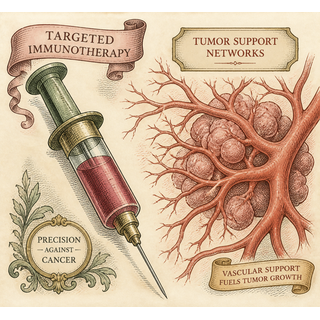
Disclaimer: The image accompanying this article is for illustrative purposes only and does not depict actual experimental results, data, or biological mechanisms.
-
Cascone T, Mountzios G. Ivonescimab in advanced squamous non-small-cell lung cancer: can we raise the survival bar? Lancet. 2026. doi:10.1016/S0140-6736(26)01026-3 ↩
-
Hegde PS, Wallin JJ, Mancao C. Predictive markers of anti-VEGF and emerging role of angiogenesis inhibitors as immunotherapeutics. Semin Cancer Biol. 2018;52(Pt 2):117-124. doi:10.1016/j.semcancer.2017.12.002 PMCID:PMC6120110 ↩
-
Finn RS, Qin S, Ikeda M, et al. Atezolizumab plus bevacizumab in unresectable hepatocellular carcinoma. N Engl J Med. 2020;382(20):1894-1905. doi:10.1056/NEJMoa1915745 ↩
-
Socinski MA, Jotte RM, Cappuzzo F, et al. Atezolizumab for first-line treatment of metastatic nonsquamous NSCLC. N Engl J Med. 2018;378(24):2288-2301. doi:10.1056/NEJMoa1716948 ↩
-
Herbst RS, Arbour KC, Rizvi H, et al. Immunotherapy for non-small cell lung cancer: facts and hopes. Clin Cancer Res. 2024;30(1):10-20. doi:10.1158/1078-0432.CCR-23-1200 ↩