Going once, going twice, sold - to the drug that finally learned some manners. For decades, cancer treatment often worked like tossing a grenade into a crowded room and hoping the tumor had the worst day. Antibody-drug conjugates, or ADCs, are more like hiring a very expensive courier who brings a lethal package to a much more specific address.
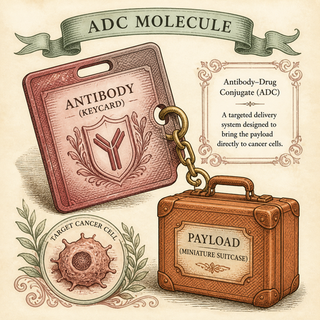
That is the big idea behind a new review on ADCs in breast cancer: these therapies are no longer a niche side act. They are moving into center stage, changing how doctors think about advanced disease, earlier treatment, side effects, resistance, and what comes next in the clinic Li et al., 2026.
The basic scam - but for good
An ADC has three main parts: an antibody, a linker, and a payload. The antibody recognizes a target on or around cancer cells. The linker holds the whole contraption together until delivery. The payload is the toxic drug that does the actual cellular wrecking ball routine.
If standard chemotherapy is a leaf blower full of poison, an ADC is more like a keycard plus a suitcase plus a tiny chaos goblin inside the suitcase.
In breast cancer, this matters because tumors are not all identical. Some carry obvious molecular flags, like HER2. Others express different markers tied to their cell lineage or developmental history. And some opportunities sit not on the cancer cells themselves, but in the tumor microenvironment - the sketchy neighborhood of immune cells, blood vessels, fibroblasts, and biochemical weirdness that helps tumors stay in business.
The review proposes a neat way to sort ADC targets into three buckets:
- Oncogenic driver antigens - targets that help power the cancer, like HER2
- Lineage and oncofetal antigens - markers linked to tissue identity or developmental programs
- Tumor microenvironment antigens - targets in the surrounding support system
That framing is useful because it reminds us breast cancer is not one villain. It is more like a franchise with too many spin-offs.
Why doctors got excited enough to cancel lunch
ADCs have become a huge deal in breast cancer because they offer something oncology has wanted forever: more punch, less collateral damage. Not zero collateral damage - let us not get carried away like a biotech earnings call - but better targeting than old-school chemo alone.
The poster child here is trastuzumab deruxtecan, which has helped redefine what HER2-targeted treatment can do, even in tumors with lower HER2 expression than doctors once considered actionable. Another major player is sacituzumab govitecan, which targets Trop-2 and has expanded options in metastatic disease. These drugs have helped push ADCs from "promising technology" into "actual thing changing practice" territory.
And they have a clever extra trick: the bystander effect. Sometimes the payload can leak into neighboring cancer cells after release, killing cells that may not express the target as strongly. In a patchy, messy tumor, that can be a big advantage. It is basically the oncology version of getting the whole annoying group chat muted, not just the loudest person.
The part where biology gets rude again
Of course, cancer never just sits there and accepts defeat. That would be wildly out of character.
The review spends a lot of time on the main headaches with ADCs:
- Drug resistance
- Toxicity
- Choosing the right patients
- Figuring out sequencing and combinations
Resistance can happen at multiple steps. Tumors may reduce target expression, alter how the ADC gets internalized, change intracellular trafficking, pump out the payload, or evolve survival pathways that let them shrug off damage. Basically, if cancer cells had LinkedIn profiles, "adaptable under pressure" would be doing a lot of work.
Toxicity also remains a serious issue. ADCs are more selective than traditional chemotherapy, but they are not magic darts from a wizard tower. Payloads are potent, and off-target effects still happen. Clinicians have to watch for problems like bone marrow suppression, gastrointestinal side effects, neuropathy, and in some cases interstitial lung disease, a particularly important concern with certain ADCs.
Where this could go next
The future looks less like one miracle drug and more like smarter strategy. The review highlights a few likely directions:
Better target hunting
Researchers are looking beyond the usual suspects to find antigens that are more tumor-specific or biologically meaningful.
Better ADC design
Newer ADCs may use improved linkers, different payloads, or bispecific antibodies that recognize more than one target. Because apparently one lockpick is no longer enough.
Better combinations
ADCs may pair well with immunotherapy, endocrine therapy, or other targeted agents. The logic is simple: hit the tumor, disrupt its hideout, and maybe help the immune system finally find the door.
Better biomarker-guided decisions
Not every patient benefits equally, and not every ADC belongs in the same spot in treatment. Biomarkers could help decide who gets which ADC, when, and in what order - less guesswork, more chess.
Why this matters outside the conference slide deck
Breast cancer treatment has been moving away from blunt categories and toward finer-grained biology. ADCs fit that shift almost perfectly. They are not just stronger drugs. They are a way of packaging treatment around what a tumor is, where it lives, and how it dodges attack.
If future studies keep confirming the benefits, ADCs could keep expanding into earlier-stage disease and more personalized treatment plans. That means more chances to control cancer, more options after resistance, and maybe fewer moments where treatment feels like trying to fix a watch with a frying pan.
The review by Li and colleagues makes one thing clear: ADCs are not a passing fad with a shiny acronym. They are becoming one of the main engineering projects in modern breast cancer care - part molecular recognition system, part drug delivery hack, part reminder that oncology keeps getting weirder in very productive ways.
References
-
Li S, Xu Z, Ruan W, Wang X, Yu H, Yi M, Fu P. Antibody-drug conjugates in breast cancer: from mechanism to revolutionizing clinical practice. Molecular Cancer. 2026;25:32. DOI: 10.1186/s12943-026-02711-9
-
Modi S, Jacot W, Yamashita T, Sohn J, Vidal M, Tokunaga E, et al. Trastuzumab deruxtecan in previously treated HER2-low advanced breast cancer. N Engl J Med. 2022;387(1):9-20. DOI: 10.1056/NEJMoa2203690
-
Bardia A, Hurvitz SA, Tolaney SM, Loirat D, Punie K, Oliveira M, et al. Sacituzumab govitecan in hormone receptor-positive/HER2-negative advanced breast cancer. N Engl J Med. 2023;389(20):1881-1892. DOI: 10.1056/NEJMoa2305488
-
Cortes J, Kim SB, Chung WP, Im SA, Park YH, Hegg R, et al. Trastuzumab deruxtecan versus trastuzumab emtansine for breast cancer. N Engl J Med. 2022;386(12):1143-1154. DOI: 10.1056/NEJMoa2115022
-
Tarantino P, Curigliano G, Tolaney SM, Cortes J, Cardoso F, Andrè F, et al. Interstitial lung disease induced by anti-HER2 antibody-drug conjugates: a review. J Clin Oncol. 2023;41(6):1243-1253. DOI: 10.1200/JCO.22.01643
Disclaimer: The image accompanying this article is for illustrative purposes only and does not depict actual experimental results, data, or biological mechanisms.