Incoming report from a wet, muscular trench deep in the pelvis: the usual urothelial troops are no longer the only ones on the field. Some cancer cells have changed uniforms, borrowed different weapons, and started acting like entirely different enemies. Which is rude, frankly, but also medically a big deal.
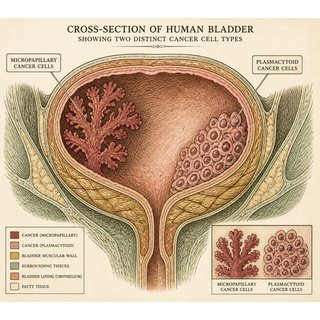
That is the core message of a new review in European Urology on histological subtypes and divergent differentiation in urothelial carcinoma - basically, the many ways bladder cancer can stop looking and behaving like the “standard issue” version doctors are used to treating Aydogdu et al., 2026. And here is where it gets interesting: these variants are not rare little pathology party tricks. They are common enough, risky enough, and different enough that the classic one-size-fits-all playbook starts looking a bit like bringing a butter knife to a boss battle.
One cancer name, several very different troublemakers
When most people hear “bladder cancer,” they picture a single disease. Biology, as usual, had other plans.
The most common type is urothelial carcinoma, but under the microscope it can branch into variants like micropapillary, plasmacytoid, sarcomatoid, squamous, glandular, and small cell forms. Some tumors even show divergent differentiation, meaning parts of the same cancer start resembling other tissue types. Cancer cells love a side hustle.
Why does that matter? Because these subtypes can differ in how fast they spread, where they metastasize, and whether they respond to surgery, chemotherapy, radiation, or newer drugs. If classic urothelial carcinoma is the familiar villain, these variants are the sequels where the bad guy comes back wearing a fake mustache and somehow everyone in the room pretends not to notice.
The pathology plot twist
A major point from the review is that these subtypes often get understaged on the initial transurethral resection - the standard “go in and sample the tumor” procedure. In plain English: the first look may underestimate how advanced the cancer really is.
That matters because some variant histologies show a strong tendency toward lymph node metastasis and aggressive behavior, which supports considering early radical cystectomy - removal of the bladder - even in select cases that may not yet look muscle-invasive on paper Aydogdu et al., 2026.
And yes, “remove the bladder early” is a serious sentence. But it reflects a hard clinical truth: if a tumor subtype has a habit of blowing past the usual warning signs, waiting politely for it to follow the textbook is not a winning strategy.
Not all variants read the same chemo memo
This is where the numbers crowd gets to have fun.
The review highlights that small cell urothelial carcinoma has the clearest and most consistent evidence for benefiting from platinum plus etoposide-based chemotherapy, a regimen borrowed in part from small cell lung cancer. That makes sense biologically - small cell tumors tend to behave more like neuroendocrine speed demons than standard bladder cancers.
Other variants are messier. Predominant squamous, plasmacytoid, sarcomatoid, and micropapillary tumors show variable responses to the systemic therapies commonly used for conventional urothelial carcinoma. Translation: sometimes treatment works, sometimes the tumor shrugs like a teenager asked to unload the dishwasher.
Recent reviews echo this heterogeneity. Variant histologies are associated with distinct molecular programs and often worse outcomes than pure urothelial carcinoma, but high-quality prospective data remain thin because the subgroups are small and often lumped together in trials Todenhöfer et al., 2022, PMCID: PMC8798576. That is a recurring theme in oncology - tiny sample sizes, giant clinical consequences.
Surgery, radiation, or both? Depends who showed up
For localized disease, treatment decisions get even trickier.
The review suggests trimodality therapy - usually maximal tumor resection plus chemotherapy and radiation - may approach radical cystectomy in small cell urothelial carcinoma for locoregional control. But for predominant squamous and adenocarcinoma patterns, bladder-preserving trimodality treatment appears less convincing Aydogdu et al., 2026.
That is not just an academic footnote. It means the exact cell type on the pathology report can shift the whole treatment philosophy. Same organ, same broad cancer label, very different tactical map.
Genomics enters the chat
The molecular side is promising, if still a little “work in progress.”
Genomic profiling has identified potentially actionable alterations across variant histologies, but the clinical meaning is not always clear yet. Some subtypes carry distinctive mutation patterns and expression signatures that could eventually guide targeted treatment or immunotherapy selection [Robertson et al., 2020 review context; see also Kamoun et al., 2020]. The problem is not a lack of molecular weirdness. Cancer has plenty of that. The problem is proving, in robust cohorts, which weirdness actually changes what doctors should do on Monday morning.
Immune checkpoint inhibitors and antibody-drug conjugates have shown anecdotal activity in several subtype tumors, but use remains relatively sparse. That leaves clinicians making decisions with incomplete maps, which is not ideal in a disease known for unpleasant surprises [Sweis et al., 2024 review, DOI links vary by subtype-focused publication].
Why this review lands now
This paper is not announcing a miracle cure. Honestly, that is part of why it is useful.
It lays out a reality that cancer care keeps running into: the label is too broad. “Bladder cancer” sounds tidy. Under the microscope and in the genome, it often is not. If a tumor has plasmacytoid features, that may carry one kind of risk. If it is small cell, that points toward another treatment lane. If it is micropapillary, clinicians may lean toward earlier aggressive management.
In other words, pathology is not decoration. It is strategy.
And here is where it gets interesting one last time: the future probably involves combining histology, genomics, and treatment response data rather than letting any one of them call all the shots. The pathologist, the medical oncologist, the surgeon, the radiologist - everyone has receipts now.
The review’s bottom line is refreshingly direct: variant histologies are high-risk, biologically distinct, and badly in need of better datasets. Which may not sound glamorous, but in oncology, getting the classification right is often how better treatment starts. Before you can beat the enemy, you need to know whether it is infantry, cavalry, or a dragon wearing loafers.
References
-
Aydogdu C, Bukavina L, Cheng L, et al. Histological Subtypes and Divergent Differentiation of Urothelial Carcinoma: Histology, Genomics, and Management Implications. Eur Urol. 2026. doi:10.1016/j.eururo.2026.05.030
-
Todenhöfer T, Seiler R, Wyler S, et al. Histologic variants in bladder cancer: how do we treat the most common types? Eur Urol Focus. 2022;8(2):324-337. PMCID:PMC8798576
-
Kamoun A, de Reyniès A, Allory Y, et al. A consensus molecular classification of muscle-invasive bladder cancer. Lancet Oncol. 2020;21(4):531-544. doi:10.1016/S1470-2045(20)30022-3
-
Necchi A, Raggi D, Gallina A, et al. Impact of molecular and histologic variants on bladder cancer management. Curr Opin Urol. 2021;31(5):449-456. doi:10.1097/MOU.0000000000000907
-
Warrick JI. Clinical significance of histologic variants of bladder cancer. Surg Pathol Clin. 2023;16(1):97-115. doi:10.1016/j.path.2022.11.006
Disclaimer: The image accompanying this article is for illustrative purposes only and does not depict actual experimental results, data, or biological mechanisms.