At 3 AM in a lab in Munich - or Brussels, or any other place where someone is reheating stale coffee next to a humming freezer - this kind of study is exactly the one that makes bench scientists squint at a figure and mutter, "Wait, that actually worked?" Because ER-positive breast cancer has a reputation. Not for being rare or obscure, but for being stubbornly polite in the most annoying possible way. It often grows more slowly than other breast cancers, yet it also tends to shrug at immunotherapy like a bouncer ignoring your fake ID.
That is why this new Nature Medicine study caught my eye: researchers tested whether stereotactic body radiation therapy (SBRT) plus durvalumab and oleclumab before surgery could shake up the immune environment in estrogen receptor-positive, HER2-negative early breast cancer enough to matter clinically and biologically.1
The problem child in sensible shoes
ER-positive breast cancer is the most common breast cancer subtype. It usually responds well to endocrine therapy - drugs that mess with estrogen signaling - but it has not been the star pupil of immunotherapy. While checkpoint inhibitors have shown clear benefit in some cancers and in certain triple-negative breast cancers, ER-positive disease tends to be what oncologists politely call "immune cold." Which is doctor-speak for: the T cells are not exactly storming the castle.
And honestly, tumors are rude. They build a whole neighborhood of suppression around themselves - bad traffic, no streetlights, security locked out of the building. In ER-positive breast cancer, the tumor microenvironment often has fewer activated immune cells and less obvious inflammation than the cancers immunotherapy loves to bully.23
So researchers have been trying to answer a reasonable question: can we make these tumors more visible - or more irritating - to the immune system?
Enter radiation with a folding chair
SBRT is a highly targeted form of radiation delivered in a few powerful doses. Besides damaging tumor cells directly, radiation can also act like a chaotic publicist. It kills cells, releases tumor antigens, stirs up interferon signaling, and sometimes makes the immune system pay attention.4 Sometimes. Biology does not sign contracts.
In this study, the team combined SBRT with durvalumab, which blocks PD-L1, and oleclumab, which targets CD73. That second target matters more than it sounds. CD73 helps generate adenosine, a molecule that acts like a "please calm down" signal in tissues. In tumors, adenosine becomes the world's worst meditation app, telling immune cells to relax while the cancer gets on with its nonsense.5
The logic here is pretty elegant:
- Radiation may release the alarm bells
- Durvalumab may stop one immune brake
- Oleclumab may block an adenosine-based suppression pathway
Basically, instead of sending one annoyed security guard to deal with the problem, the researchers tried opening the doors, cutting the power to the tumor's fog machine, and calling in backup.
What the study found
This was a neoadjuvant study, meaning treatment happened before surgery, which gives researchers a rare chance to compare tumor tissue before and after therapy. That is catnip for translational scientists. If you have ever spent six months optimizing an immunohistochemistry panel so one figure can exist, you know exactly why.
The paper reports that the combination was feasible and generated notable immune remodeling in these ER-positive tumors.1 The interesting part is not just whether tumors shrank dramatically - though clinical response always matters - but that the treatment appeared to change the tumor microenvironment, including evidence of greater immune activation and shifts in cell populations that suggest a more inflamed state.
That matters because in a cancer type where immunotherapy usually underwhelms, seeing the microenvironment move at all is a bit like discovering the office printer responds to kindness. Suspicious, but encouraging.
The study also fits with a broader push in oncology: stop treating "cold" tumors as permanently uninteresting and start asking what combinations can warm them up.34
Why people in oncology will keep talking about this
First, ER-positive breast cancer is common. Even a modest improvement in how we prime these tumors for immune attack could affect a lot of patients.
Second, the study goes after mechanism, not just outcome. It asks how radiation and dual immune modulation might work together in real human tumors, not just in mouse models where every therapy seems to cure cancer by Thursday.
Third, it targets the adenosine pathway, which has become an area of serious interest across cancer immunology. The PD-1/PD-L1 axis gets all the celebrity treatment, but tumors use plenty of backup tricks. Adenosine is one of those deeply annoying backup tricks.56
The catch, because there is always a catch
This is not the moment to start acting like every ER-positive patient should get this regimen tomorrow morning. Early-phase studies are where hope and caution have to carpool.
Questions still hanging in the air include:
- How durable are the benefits?
- Which patients are most likely to respond?
- Does immune remodeling translate into better long-term outcomes?
- What toxicities show up when these approaches scale?
- Is this better than other neoadjuvant combinations, or just more complicated?
Also, neoadjuvant biomarker-rich studies are powerful, but they can tempt us into falling in love with beautiful correlative data. And I say that as someone who absolutely has fallen in love with beautiful correlative data. Then six months later, a larger trial arrives and reminds everyone that biology is a raccoon in a lab coat.
The bigger picture
If these findings hold up, the real significance is not just this exact drug combo. It is the broader idea that ER-positive breast cancer may be more immunologically pliable than we gave it credit for - if you push the right pathways at the right time.
That would be a meaningful shift. Not a miracle. Not a movie montage. Just a smarter way of turning a usually quiet tumor into one the immune system can no longer ignore.
And in cancer research, that kind of progress often starts not with fireworks, but with one strange, carefully controlled study that makes a tired scientist look up from a pathology slide and say, "Huh. Well that's new."
References
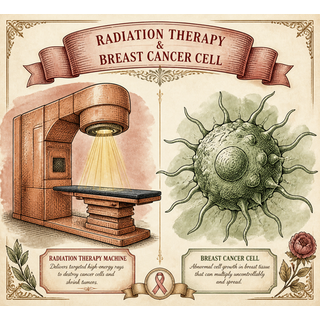
Disclaimer: The image accompanying this article is for illustrative purposes only and does not depict actual experimental results, data, or biological mechanisms.
-
De Caluwé A, Desmoulins I, Cao K, et al. Neoadjuvant stereotactic body radiation therapy with durvalumab and oleclumab in ER-positive breast cancer. Nat Med. 2026. doi:10.1038/s41591-026-04453-z ↩↩
-
Loi S, Salgado R, Adams S, et al. Tumor infiltrating lymphocytes and prognosis in triple-negative breast cancer: practical insights and broader implications for breast cancer immunobiology. Ann Oncol. 2017;28(8):1697-1704. doi:10.1093/annonc/mdx268 ↩
-
Schmid P, Salgado R, Park YH, et al. Pembrolizumab plus chemotherapy as neoadjuvant treatment of high-risk, early-stage triple-negative breast cancer. N Engl J Med. 2020;382:810-821. doi:10.1056/NEJMoa1910549 ↩↩
-
Vanpouille-Box C, Demaria S, Formenti SC, Galluzzi L. Cytotoxic therapy and radiation to fuel antitumor immunity. Cancer Cell. 2018;33(4):563-565. doi:10.1016/j.ccell.2018.03.018 ↩↩
-
Allard B, Allard D, Buisseret L, Stagg J. The adenosine pathway in immuno-oncology. Nat Rev Clin Oncol. 2020;17(10):611-629. doi:10.1038/s41571-020-0382-2 ↩↩
-
Leone RD, Emens LA. Targeting adenosine for cancer immunotherapy. J Immunother Cancer. 2018;6:57. doi:10.1186/s40425-018-0360-8 ↩