Cancer tissue is less like a tidy neighborhood and more like a city with illegal lane changes, blocked exits, and a suspicious number of unmarked vans. This paper hands researchers a better traffic camera - one that can finally spot extracellular vesicles, those tiny membrane-wrapped parcels cells send to one another, while they’re still on the road instead of after the whole pileup has been towed away.
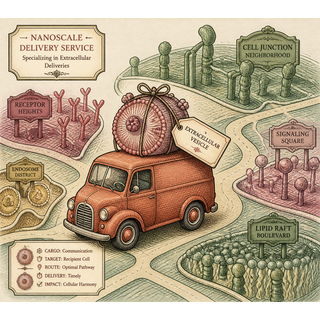
The study introduces Spatial-EV-seq, a method for mapping extracellular vesicles - usually shortened to EVs - directly inside tissue, while preserving where they sit and which cells they seem to be chatting with nearby. If you work around cancer trials, this is the sort of thing that makes you put down your coffee and read the methods twice, because "we preserved spatial context" often turns out to mean "we had a brave dream and a complicated figure legend." Here, though, the idea is pretty elegant.
Tiny packages, big gossip
EVs are little bubbles released by cells. They carry proteins, RNA, and other molecular odds and ends. Think of them as text messages wrapped in snack-sized Tupperware. Healthy cells use them. Tumor cells use them. Immune cells use them. Everyone’s sending notes.
The catch is that most EV methods grind up tissue or collect fluids like blood, which tells you what EVs exist but not where they came from or who they’re influencing nearby. That matters a lot in cancer, where location is half the plot. A PDL1-positive vesicle drifting around next to a T cell means something very different from the same vesicle sitting across town near a fibroblast.
Spatial biology has already shown that tumors are not uniform blobs. They are patchworks of micro-neighborhoods with different immune pressures, oxygen levels, and bad attitudes. Spatial-EV-seq tries to add EVs to that map.
What the authors actually built
The team created an antibody-engineered capture interface that holds EVs in place within tissue. Then they used surface-binding aptamers and rolling circle amplification to light up and profile individual vesicles. In plain English: they built a way to catch tiny vesicles where they naturally sit, tag them based on molecular features, and read out that information with enough sensitivity to connect EV patterns to nearby cells and tissue architecture.
That is the trick here. Not just detecting EVs. Detecting them in situ, with spatial resolution, and integrating that with transcriptomic information from surrounding cells.
In a breast cancer mouse model treated with anti-PD1 therapy, the method pointed to a spatially organized immunosuppressive axis involving PDL1-positive EVs. The abstract truncates before laying out the full chain of events, but the key message is clear: EVs were not just background molecular confetti. They appeared woven into local immune suppression in ways that depended on where they were in the tissue.
That’s a big deal because immunotherapy often feels like trying to fix citywide traffic by adjusting one stoplight. Some patients respond beautifully. Others do not. The tumor microenvironment keeps rerouting the problem.
Why this is more than a fancy microscope flex
If these findings hold up, spatial EV profiling could help answer some annoying and expensive questions in oncology:
- Why does one part of a tumor respond to therapy while another part shrugs?
- Which cells are sending suppressive signals to immune cells?
- Can EV patterns predict resistance before scans do?
- Are there targetable EV-mediated communication routes we’ve been missing?
That last one is especially interesting. We already care about PD-1/PD-L1 biology in immunotherapy, but this work hints that part of the action may involve vesicle-based delivery of suppressive signals, not just surface protein handshakes between neighboring cells. Same cast, different transportation infrastructure.
For clinicians and trialists, this raises a very practical fantasy: one day, spatial EV features might help stratify patients, identify early resistance niches, or explain why a "negative" bulk biomarker missed the real action happening in a small but nasty tumor region. Biomarker development is where optimism goes to get audited, so nobody should start writing regulatory briefing documents just yet. Still, the concept has teeth.
The catch, because there is always a catch
This is a methods paper, and methods papers live or die on reproducibility, robustness, and whether normal humans in other labs can make the thing work without summoning three postdocs and a lunar alignment.
A few obvious next questions:
- How well does Spatial-EV-seq perform across tissue types and fixation conditions?
- Can it scale beyond specialized labs?
- How confidently can it assign EV origin and recipient relationships, rather than just spatial proximity?
- Will human clinical samples behave as nicely as curated model systems rarely do?
Those are not deal-breakers. They are the usual toll booths on the road from cool technology to useful tool.
Why this one sticks
The most interesting part of this paper is not just that it detects tiny vesicles. It treats them as part of the spatial logic of cancer. Tumors are ecosystems. EVs may be one of the courier services keeping the ecosystem running - sometimes helping immune cells coordinate, sometimes helping tumors slip fake credentials past security.
And if we can map that courier network, we might get better at spotting where immune suppression starts, how resistance spreads, and which detours a tumor uses when therapy blocks the main road.
Which, honestly, is the dream in oncology: not just knowing the bad neighborhood exists, but finally getting a street-level map.
References
-
Wen Q, Na X, Lu Y, et al. Spatially resolved profiling of extracellular vesicles in tissues with Spatial-EV-seq. Nat Biotechnol. 2026. doi:10.1038/s41587-026-03192-3
-
Kalluri R, LeBleu VS. The biology, function, and biomedical applications of exosomes. Science. 2020;367(6478):eaau6977. doi:10.1126/science.aau6977
-
Yáñez-Mó M, Siljander PRM, Andreu Z, et al. Biological properties of extracellular vesicles and their physiological functions. J Extracell Vesicles. 2015;4:27066. doi:10.3402/jev.v4.27066 PMCID:PMC4382210
-
Lewis SM, Asselin-Labat ML, Nguyen Q, et al. Spatial omics and multiplexed imaging to explore cancer biology. Nat Methods. 2021;18(9):997-1012. doi:10.1038/s41592-021-01203-6
-
Hsu YL, Hung JY, Chang WA, Tsai YM, Pan YC, Huang MS, Kuo PL. Hypoxic lung cancer-secreted extracellular vesicle microRNA promotes tumorigenesis and anti-PD-1 resistance. Mol Cancer. 2024;23:35. doi:10.1186/s12943-024-01953-4 PMCID:PMC10834567
Disclaimer: The image accompanying this article is for illustrative purposes only and does not depict actual experimental results, data, or biological mechanisms.