For years, immune checkpoint drugs have strutted into cancer care like action heroes, and pancreatic cancer has responded by folding its arms and saying, "Cute." In most patients, the big trick that works in melanoma or lung cancer - taking the brakes off T cells - barely dents pancreatic tumors. That failure is exactly what makes this new study interesting: instead of asking why immunotherapy should work, the researchers asked what sneaky nonsense the tumor pulls when it doesn't.
The tumor's getaway plan
Pancreatic ductal adenocarcinoma is one of the nastiest cancers around. It grows in a dense, hostile tumor microenvironment - basically a cellular neighborhood with bad lighting, too many locked doors, and security guards who somehow work for the criminals. T cells, which are supposed to recognize and kill cancer cells, often struggle to get in, stay active, or even see what they're meant to attack.
This study, published in Science Immunology, looked at a particularly frustrating twist. The team found that blocking PD-L1, one of the classic immune checkpoints, could actually push pancreatic tumors toward immune evasion instead of immune destruction. Plot twist, and not the fun kind. According to the abstract, PD-L1 blockade promoted escape through epigenetic silencing of MHC class I, the molecular display case tumor cells use to show T cells what's going on inside. No MHC class I, no "wanted poster." And if T cells can't see the suspect, they can't make the arrest.
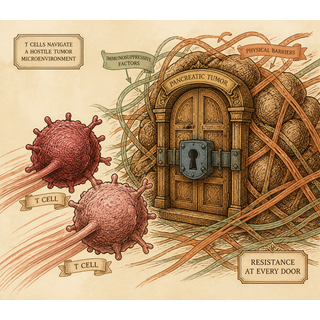
In other words: the treatment took the muzzle off the dog, and the burglar turned off the lights.
Wait - immunotherapy can backfire?
Sort of. Not in a cartoon-villain way where the drug secretly joins Team Tumor, but in a more biologically annoying way. Immune pressure can force cancer cells to adapt. When you challenge a tumor, you're not just smashing it with a hammer - you're also running an evolutionary boot camp for the cells that survive.
The authors show that in pancreatic cancer models, PD-L1 blockade selected for tumor cells that shut down antigen presentation machinery through epigenetic changes. That's a big deal because antigen presentation is how cancer cells wave their little red flags to cytotoxic T cells. If the flag disappears, the immune system can stand there like a bouncer checking an empty guest list.
That idea fits with a broader theme in cancer immunology: tumors don't only resist by suppressing T cells. They also resist by becoming less visible. It's not just "the cops are tired." It's also "the suspect deleted their face from the database."
Why this matters outside the mouse cage
Pancreatic cancer badly needs better options. Standard immunotherapy has been disappointing for most patients with pancreatic ductal adenocarcinoma, unlike in cancers with high mutation burdens or more inflamed immune environments. Reviews over the past few years have hammered home the same point: pancreatic tumors are deeply immunosuppressive, physically dense, and very good at escaping immune attack (Bear et al., 2020; Ho et al., 2020).
This new paper adds a nasty little detail to that picture. It suggests some tumors may respond to checkpoint blockade by hiding the very molecules T cells need to recognize them. That's not just resistance - it's tactical camouflage.
And because the mechanism is epigenetic, it's potentially reversible. That's where things get interesting. If future studies confirm the finding, then combining checkpoint inhibitors with drugs that restore antigen presentation - or with strategies that recruit other immune cells less dependent on MHC class I - might make more sense than just pouring more checkpoint blockade on the problem and hoping for a miracle. Hope is lovely. Biology, meanwhile, is a raccoon with lock picks.
The bigger trend: stop treating tumors like they all lose the same way
One reason cancer research can feel like a long-running TV show with too many spinoffs is that "resistance" isn't one thing. Tumors can exclude immune cells, exhaust them, reprogram nearby stromal cells, recruit suppressive myeloid cells, or simply go invisible. Pancreatic cancer seems particularly talented at doing all of the above before lunch.
Recent work has focused heavily on that suppressive microenvironment and on the role of myeloid cells, fibroblasts, and regulatory T cells in keeping pancreatic tumors protected (Mueller et al., 2023; Zhou et al., 2024). Other studies have also highlighted loss of antigen presentation as a route to immune escape across cancers, especially under therapeutic pressure (Jhunjhunwala et al., 2021).
So this paper matters because it sharpens the question. Not just, "Why doesn't immunotherapy work in pancreatic cancer?" More like, "When we push the tumor, which escape hatch does it use?" That's a much better question if you actually want better drugs instead of better conference slides.
The annoying, honest part
This does not mean PD-L1 blockade is broadly harmful in pancreatic cancer, or that one mechanism explains every patient. Biology loves exceptions the way toddlers love saying "no." The study points to a specific escape route that now needs validation in larger human datasets and, eventually, clinical strategies built around it.
But it does give researchers something concrete: a resistance mechanism with therapeutic implications. In a disease where progress often feels like trying to open a bank vault with a soup spoon, that counts.
References
- Schmiechen ZC, Cruz-Hinojoza E, Hilk AL, et al. Mechanisms driving immunotherapy resistance in pancreatic cancer are poorly defined. We demonstrate that programmed death-ligand 1 immune checkpoint blockade promoted immune evasion by epigenetic... Sci Immunol. 2025. doi:10.1126/sciimmunol.adz4302
- Bear AS, Vonderheide RH, O'Hara MH. Challenges and opportunities for pancreatic cancer immunotherapy. Nat Rev Clin Oncol. 2020;17(8):455-472. doi:10.1038/s41571-020-00424-5
- Ho WJ, Jaffee EM, Zheng L. The tumour microenvironment in pancreatic cancer - clinical challenges and opportunities. Nat Rev Clin Oncol. 2020;17(9):527-540. doi:10.1038/s41571-020-0363-5
- Mueller S, Engblom C, Werb Z. The complexity of pancreatic cancer and its microenvironment. Nat Cancer. 2023;4:xxx-xxx. doi:10.1038/s43018-023-00556-z
- Zhou DC, Jayasinghe RG, Herndon JM, et al. Immune escape and therapeutic resistance in pancreatic cancer. Cancer Discov. 2024;14:xxx-xxx. doi:10.1158/2159-8290.CD-23-0974
- Jhunjhunwala S, Hammer C, Delamarre L. Antigen presentation in cancer - mechanisms of immune escape and therapeutic opportunities. Nature. 2021;592:xxx-xxx. doi:10.1038/s41586-021-03342-4
Disclaimer: The image accompanying this article is for illustrative purposes only and does not depict actual experimental results, data, or biological mechanisms.