That is the puzzle at the center of a new Gut paper on hepatocellular carcinoma (HCC), the most common form of liver cancer. Immune checkpoint drugs like anti-PD-1 or anti-PD-L1 are supposed to help your T cells spot and attack cancer. In HCC, though, those T cells often look like security guards who showed up to work and found the doors chained shut, the lights off, and someone suspiciously shredding the guest list.
This study points a finger at NEK9, a kinase better known for helping cells manage division. The twist is that NEK9 may also help tumors build an immunosuppressive microenvironment - basically a sketchy neighborhood that makes immune attack much harder. And when researchers blocked NEK9, the tumor environment became less hostile and PD-L1 immunotherapy worked better.1
The puzzle piece nobody expected
HCC has a reputation for being hard to treat. Part of that comes from the liver itself, which normally has to stay pretty chill immunologically because it is constantly exposed to food antigens, gut-derived molecules, and all sorts of biological chaos. If the immune system treated every passing molecule like an invading army, lunch would become an international incident.
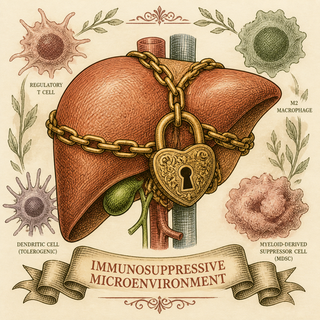
Cancer takes advantage of that built-in tolerance. Many HCC tumors are packed with suppressive immune cells, exhausted T cells, and molecular signals that tell the immune system to stand down. So while checkpoint inhibitors have changed cancer care in some settings, in liver cancer the response rates still leave plenty of room for dramatic improvement.23
That is where NEK9 enters, wearing the kind of name only a molecular biologist could love.
What the researchers actually found
The team looked at HCC patient samples and found that NEK9 was upregulated in tumors and associated with worse survival. High NEK9 also lined up with fewer CD8 T cells inside tumors - not a great sign, since CD8 T cells are the immune system's specialist hit squad.
Then they moved into cell models and orthotopic mouse models, where tumors grow in the liver rather than in some random anatomical Airbnb. That matters, because the liver microenvironment is a huge part of the story.
Using single-cell RNA sequencing, flow cytometry, and multiplex immunohistochemistry, the researchers mapped how NEK9 affects the tumor ecosystem. Their central finding: blocking NEK9 did not just slow tumor behavior directly - it reshaped the immune environment around the tumor.1
In plainer English, this was not just about whacking cancer cells with a molecular hammer. It was about changing the neighborhood so immune cells could actually do their jobs.
And then came the satisfying part of the puzzle: NEK9 inhibition synergized with PD-L1 blockade. Translation: the combo worked better than you'd expect from either treatment alone.
Why this matters beyond one protein with a very biotech name
Cancer immunotherapy often lives or dies by context. You can have a perfectly capable T cell, a perfectly good checkpoint inhibitor, and still get nowhere if the tumor microenvironment is sending nonstop “nothing to see here” signals.
That is why this paper is interesting. It suggests that tumor-intrinsic biology - meaning machinery inside the cancer cell itself - can help create immune resistance. NEK9 may be one of those hidden leprogrammers shaping who gets into the tumor, who gets shut down, and who leaves demoralized like they just attended a three-hour meeting that could have been an email.
This fits a broader trend in HCC research. Scientists are increasingly focusing not just on checkpoint molecules, but on the cellular and signaling architecture that determines whether immunotherapy can even get traction.24 Reviews over the past few years have emphasized that effective treatment may require remodeling the microenvironment, not merely releasing one inhibitory brake.23
The bigger mosaic
Put this paper next to recent work in liver cancer, and a pattern starts to emerge.
First, HCC is not one disease in one mood. It contains multiple immune states - inflamed, excluded, suppressed, chaotic, and occasionally all before noon. Single-cell studies have shown just how varied these tumor ecosystems can be.4
Second, many successful strategies now aim for combination therapy. The best-known example in advanced HCC is the combination of atezolizumab plus bevacizumab, which helped move the field beyond monotherapy thinking.5 The lesson is simple: if the tumor has built several layers of defense, you probably need more than one crowbar.
Third, kinases are not just cell-cycle gadgets. They can influence cytokine signaling, immune recruitment, and stromal behavior. So a target like NEK9 could matter because it sits at an intersection - one of those annoying but useful crossroads where tumor growth and immune escape keep exchanging notes.
A few caveats before anyone starts printing NEK9 T-shirts
This is promising preclinical and translational work, but it is not yet proof that NEK9-targeted therapy will help patients in the clinic. We still need to know:
- whether NEK9 inhibition is safe enough for humans
- which HCC patients are most likely to benefit
- whether the effect holds up across the messy diversity of real tumors
- how NEK9 interacts with existing standard-of-care regimens
That last point matters a lot. Cancer biology loves a plot twist, and not the fun kind. A target can look terrific in models and then behave like a folding chair in a hurricane during clinical testing.
Still, this study gives the field a compelling new clue: some liver tumors may resist immunotherapy partly because NEK9 helps engineer an immune-hostile environment. Disable that system, and checkpoint blockade may finally get into the building.
That is the kind of puzzle piece researchers love - not because it solves everything, but because suddenly several weird edges start fitting together.
References
Disclaimer: The image accompanying this article is for illustrative purposes only and does not depict actual experimental results, data, or biological mechanisms.
-
Lu G, Du R, Wan Y, et al. Targeting NEK9 synergises with immunotherapy in hepatocellular carcinoma by remodelling the immunosuppressive microenvironment. Gut. 2026. doi:10.1136/gutjnl-2026-338449 ↩↩
-
Llovet JM, Kelley RK, Villanueva A, et al. Hepatocellular carcinoma. Nat Rev Dis Primers. 2021;7(1):6. doi:10.1038/s41572-020-00240-3 ↩↩↩
-
Kurebayashi Y, Ojima H, Tsujikawa H, et al. Landscape of immune microenvironment in hepatocellular carcinoma and its additional impact on histological and molecular classification. Hepatology. 2022;75(6):1493-1510. doi:10.1002/hep.32218 ↩↩
-
Zhang Q, He Y, Luo N, et al. Landscape and dynamics of single immune cells in hepatocellular carcinoma. Cell. 2019;179(4):829-845.e20. doi:10.1016/j.cell.2019.10.003 ↩↩
-
Finn RS, Qin S, Ikeda M, et al. Atezolizumab plus bevacizumab in unresectable hepatocellular carcinoma. N Engl J Med. 2020;382(20):1894-1905. doi:10.1056/NEJMoa1915745 ↩