Triple-negative breast cancer, or TNBC, is the oncology equivalent of trying to stop a bank robber who keeps changing outfits, exits through the ceiling, and somehow steals your treatment options on the way out. It does not carry the usual hormone receptors or HER2 target, so doctors lose some of their best precision tools before the game even starts. Now a new paper in Advanced Materials describes a nanoparticle built to hit TNBC with a three-part immune wake-up call centered on the cGAS-STING pathway - basically the cell’s internal "something shady is happening here" hotline.1
The tumor alarm system, now with extra batteries
Let’s translate the alphabet soup.
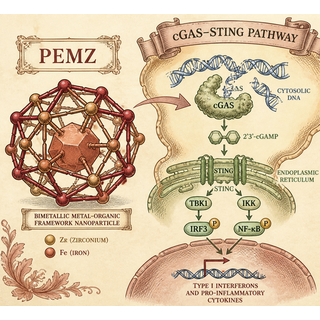
The cGAS-STING pathway is part of your innate immune system. When DNA shows up in the wrong place - like floating around in the cell’s cytoplasm instead of staying politely in the nucleus - cGAS detects it and makes a small messenger called cGAMP. That messenger then activates STING, which helps trigger interferon signaling and other immune responses. In plain English: the cell notices suspicious molecular nonsense and calls for backup.23
Cancer, being a world-class cheat, often finds ways to mute that alarm. One of those tricks involves ENPP1, an enzyme that breaks down extracellular cGAMP. So even if tumor cells or nearby immune cells try to send out "help, invader" signals, ENPP1 can basically act like the guy who unplugs the smoke detector because it’s "too loud." Terrible roommate behavior. Surprisingly common in tumors.4
What these researchers actually built
The new study designed a bimetallic metal-organic framework nanoparticle called PEMZ. Yes, the name sounds like either a prog-rock band or a medication with six side effects and a sunset commercial. But the idea is clever.
This nanocomplex carries siRNA against ENPP1 - a genetic silencer meant to reduce ENPP1 levels. The carrier is built from a manganese-containing ZIF-8 type framework and modified with PEI, which helps package and deliver the siRNA. Once the complex reaches the acidic tumor environment or gets taken into cells, it releases its cargo into the cytoplasm.1
According to the authors, PEMZ activates cGAS-STING in three ways at once:
- It knocks down ENPP1, so cGAMP sticks around longer instead of getting chopped up.
- It releases Mn ions, which can enhance cGAS sensitivity and amplify signaling.
- It promotes oxidative stress and DNA damage-related signals, generating more of the kind of cellular chaos that can feed into cGAS-STING activation.
That is the central gimmick here: not one nudge, not two nudges, but a triple espresso shot for an immune pathway that tumors usually keep half-asleep.
Why TNBC needed this kind of chaos
TNBC is notoriously hard to treat because it is aggressive, genetically messy, and often surrounded by an immune microenvironment that ranges from "indifferent" to "actively unhelpful." Immunotherapy has improved outcomes for some patients, but many tumors remain cold, meaning they do not draw enough effective immune activity to become easy targets.56
So researchers keep looking for ways to turn cold tumors hot. cGAS-STING has become a major candidate because it can link tumor damage to immune activation. If you can get that pathway firing in the right place, you may recruit dendritic cells, prime T cells, and generally make the tumor neighborhood less cozy for cancer cells.23
This paper matters because it tries to solve several problems at once: protecting siRNA from breakdown, getting it into tumor cells, reducing a tumor defense mechanism, and boosting innate immune signaling with the nanoparticle itself. That is a lot of jobs for one little package. Honestly, if this nanoparticle also answered emails, academia would tenurize it immediately.
What they found, and why people will pay attention
The authors report that PEMZ suppressed tumor growth and remodeled the tumor immune environment in preclinical TNBC models.1 The appeal is not just that the nanoparticle killed cancer cells more effectively than simpler approaches. It is that it may have made the immune system more willing to join the fight.
That is a big deal because cancer therapy increasingly works best when it stops acting like a lone action hero and starts assembling a team. Surgery, chemo, radiation, immunotherapy, targeted delivery, innate immune activation - modern oncology is basically The Avengers, but with more flow cytometry and fewer capes.
If results like this hold up, a platform like PEMZ could eventually fit into combination strategies for TNBC and possibly other "immune-cold" cancers where ENPP1 and cGAS-STING biology matter.
The giant asterisk, wearing sensible shoes
Now for the buzzkill, because science always brings one.
This is still preclinical work. Nanomedicine is full of beautiful mouse data and sad human follow-up. Delivering RNA safely, specifically, and reproducibly in patients is hard. Activating STING can also be a double-edged sword - too little does nothing, too much can drive toxic inflammation. And tumors are not one enemy; they are a whole dysfunctional group chat of cancer cells, stromal cells, suppressive immune cells, and bad decisions.
So the concept is exciting, but it still needs the usual gauntlet: reproducibility, toxicity studies, dosing work, manufacturing consistency, and eventually human trials.
Still, this paper taps into a very live idea in oncology: don’t just attack the tumor directly - make the tumor accidentally snitch on itself.
References
Disclaimer: The image accompanying this article is for illustrative purposes only and does not depict actual experimental results, data, or biological mechanisms.
-
Chen S, Shi M, Chen Y, Wang Y, Li Y, Yang D, Guo J, Mao C. An siENPP1-Delivering Bimetallic MOF Nanocomplex Enables Triple Activation of the cGAS-STING Pathway for Synergistic Triple-Negative Breast Cancer Therapy. Adv Mater. 2025:e73878. doi:10.1002/adma.73878. PubMed: 42351323 ↩↩↩
-
Hopfner KP, Hornung V. Molecular mechanisms and cellular functions of cGAS-STING signalling. Nat Rev Mol Cell Biol. 2020;21(9):501-521. doi:10.1038/s41580-020-0244-x. ↩↩
-
Li A, Yi M, Qin S, Song Y, Chu Q, Wu K. Activating cGAS-STING pathway for the optimal effect of cancer immunotherapy. J Hematol Oncol. 2024;17:26. doi:10.1186/s13045-024-01578-5. PMCID: PMC10894233 ↩↩
-
Bakhoum SF, Ngo B, Laughney AM, et al. Chromosomal instability drives metastasis through a cytosolic DNA response. Nature. 2018;553(7689):467-472. doi:10.1038/nature25432.
Related recent perspective on ENPP1 and extracellular cGAMP signaling: Carozza JA, Böhnert V, Nguyen KC, et al. Extracellular cGAMP is a cancer-relevant immunotransmitter. Cancer Cell. 2020;38(3):319-321. doi:10.1016/j.ccell.2020.08.006. ↩ -
Garrido-Castro AC, Lin NU, Polyak K. Insights into molecular classifications of triple-negative breast cancer: improving patient selection for treatment. Cancer Discov. 2019;9(2):176-198. doi:10.1158/2159-8290.CD-18-1177. ↩
-
Emens LA. Breast cancer immunotherapy: facts and hopes. Clin Cancer Res. 2024;30(1):7-17. doi:10.1158/1078-0432.CCR-23-1946. ↩