Extranodal NK/T-cell lymphoma - ENKTCL, for those of us who enjoy acronyms that look like someone fell asleep on the keyboard - used to walk into the treatment office like a doomed draft pick. Bad prognosis. Brutal biology. Old chemo plans that looked fine on paper and then got absolutely cooked on the field. But this new review in CA: A Cancer Journal for Clinicians tells a much better story: this once-fatal lymphoma has, in many cases, become treatable and even curable with smarter, more tailored strategies.1
That is a big deal. Not "nice little incremental update" big. More like "the franchise used to go 2-15 and now has a playoff plan" big.
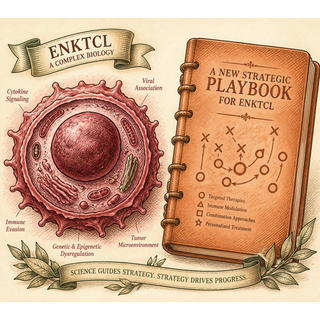
Meet the opponent: a nasty lymphoma with viral backup
ENKTCL is an aggressive type of non-Hodgkin lymphoma that usually starts outside lymph nodes, often in the nose and upper airway. It is strongly linked to Epstein-Barr virus, or EBV - yes, the same virus famous for mononucleosis, now revealing it also has a very dark side hustle.12
This cancer is more common in parts of Asia and Latin America than in Europe or North America.1 Biologically, it is messy in all the worst ways: genomic instability, weird metabolism, immune evasion, and EBV-driven tumor behavior. In sports terms, this tumor is not just running one play. It has a whole offensive playbook, a trick-play package, and apparently a special teams unit.
That complexity is exactly why old-school anthracycline-heavy chemotherapy struggled. ENKTCL cells often resist those drugs, partly because they express multidrug resistance proteins that basically act like bouncers tossing the medicine out of the club.13
The old game plan got benched
For years, standard chemo regimens borrowed from other lymphomas just did not perform well here. The disease was often devastating, especially when advanced or relapsed.1 But doctors stopped trying to force a bad matchup and started asking a better question: what does this lymphoma actually depend on?
Turns out ENKTCL has a few exploitable weaknesses. One of the biggest is metabolism. These tumor cells can be vulnerable to asparaginase-based therapy, which deprives them of a key nutrient source. That shift changed the scoreboard in a hurry.14
In early-stage disease, the current playbook usually combines radiotherapy with non-anthracycline regimens, often including asparaginase. Radiation matters a lot because many tumors are still localized at diagnosis, especially in the nasal region.15 Instead of swinging wildly with generic chemo, clinicians now run a coordinated offense: local control plus biologically informed systemic therapy. Competent coaching. Finally.
Why the comeback happened
The review lays out the core reason outcomes improved: treatment started matching the biology.
For early-stage ENKTCL, combined-modality therapy is now standard. For advanced-stage disease, treatment leans more heavily on therapies that target immune dysfunction and metabolic vulnerabilities.1 The result is dramatic enough to sound fake if you have followed this disease for a while - nearly 80% of patients with newly diagnosed ENKTCL can now achieve long-term survival.1
That does not mean the game is won. Relapsed or refractory disease remains the ugly fourth quarter nobody wants. But even there, the bench is deeper than it used to be.
Immune checkpoint inhibitors have shown promise, especially because ENKTCL often has features that make immune escape a central part of its strategy.16 EBV itself is also becoming a target, which is one of the more satisfying plot twists in modern oncology: if the virus helped build the problem, maybe we can use that viral signature against the tumor. Cellular therapies and EBV-directed vaccines are now in the conversation.1
The playoff hopefuls: new drugs, smarter targeting
This is where the article gets especially interesting. Investigators are not just throwing random molecules at the wall and seeing what sticks - although, to be fair, drug development can sometimes look like that from the cheap seats. They are targeting surface antigens, signaling pathways, metabolism, and viral mechanisms.1
That broader strategy fits what we now know from recent molecular studies and reviews: ENKTCL is not one disease in the simple sense. It is a biologically layered opponent shaped by EBV, immune interactions, and recurrent genomic alterations.27 Precision medicine is not just a buzz phrase here - it is the only way this sport makes sense.
Stem cell transplantation still has a role, but not as a one-size-fits-all move. The review argues it helps selected high-risk patients who respond to therapy, and in ENKTCL-associated hemophagocytic lymphohistiocytosis - a terrifying hyperinflammatory complication with absolutely zero chill.1 It is not recommended for early-stage disease, which is an important example of modern oncology getting more selective instead of just more intense.
The real headline
The headline is not simply that doctors found a better drug combo. It is that ENKTCL went from "nearly hopeless" to "often beatable" because researchers stopped treating it like generic lymphoma and started respecting its weirdness.
Cancer biology is, once again, a reminder that the opponent never just lines up in a basic defense. There is always a hidden formation, a fake handoff, a viral co-conspirator, and some metabolic nonsense happening off-camera. But when the scouting report gets better, treatment gets sharper.
And that is what makes this review worth your attention. It is a map of how a lethal disease got dragged into a more winnable era - through radiation, asparaginase, immunotherapy, molecular targeting, and a much better understanding of EBV's role in the whole mess.
For patients and clinicians, that is not hype. That is the kind of turnaround season people remember.
References
Disclaimer: The image accompanying this article is for illustrative purposes only and does not depict actual experimental results, data, or biological mechanisms.
-
Xiong J, Kwong YL, de Leval L, Qi SN, Ong CK, Gaulard P, Jaccard A, Horwitz SM, Li YX, Chen SJ, Suzuki R, Kim WS, Zhao WL. Extranodal natural killer/T-cell lymphoma: From fatal to curable. CA Cancer J Clin. 2025. doi:10.3322/caac.70094. PubMed: 42372027 ↩↩↩↩↩↩↩↩↩↩↩↩↩
-
Tse E, Kwong YL. How I treat NK/T-cell lymphomas. Blood. 2022;140(5):459-470. doi:10.1182/blood.2021015179 ↩↩
-
Yamaguchi M, Suzuki R, Oguchi M. Advances in the treatment of extranodal NK/T-cell lymphoma, nasal type. Blood. 2018;131(23):2528-2540. doi:10.1182/blood-2017-12-791418 ↩
-
Bi XW, Jiang WQ, Zhang WW, et al. Current treatment of extranodal NK/T-cell lymphoma. Hematol Oncol. 2021;39 Suppl 1:45-52. doi:10.1002/hon.2858 ↩
-
Wang H, Li YX, Wang WH, et al. Radiotherapy improves survival in early-stage extranodal NK/T-cell lymphoma. Cancer Med. 2020;9(15):5410-5419. doi:10.1002/cam4.3205 ↩
-
Chan TSY, Li J, Loong F, et al. PD1 blockade with pembrolizumab is highly effective in relapsed or refractory NK/T-cell lymphoma failing l-asparaginase. Blood. 2018;129(17):2437-2442. doi:10.1182/blood-2016-12-756841 ↩
-
Lim JQ, Huang D, Tang T, et al. Whole-genome sequencing identifies therapeutic targets in natural killer/T cell lymphoma. Nat Commun. 2020;11:5836. doi:10.1038/s41467-020-19684-6 ↩