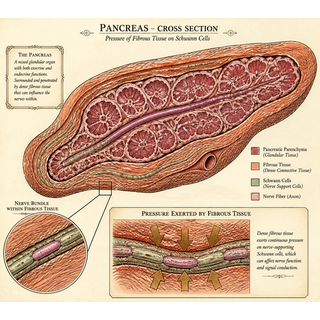
Knead dough long enough and it stiffens under your hands; apparently pancreatic tumors have been taking notes. In this paper, researchers found that the dense, scar-like fibrosis around pancreatic cancer does more than make the neighborhood tough - it physically presses on nearby Schwann cells, the nerve-support cells of the body, and nudges them into a tumor-helping mood. Which is, frankly, rude behavior from connective tissue.
Pancreatic ductal adenocarcinoma, or PDAC, already has a grim reputation. It grows in a thick fibrous shell, resists treatment, and recruits all sorts of cellular accomplices. Scientists have known for a while that nerves matter in this disease, and that activated Schwann cells can help cancer cells invade surrounding tissue. What was less clear was how those Schwann cells got switched on in the first place. This study suggests the answer is not just chemistry. It is pressure.
A sketchy neighborhood gets even sketchier
PDAC is famous for fibrosis - a buildup of dense extracellular matrix that makes the tumor microenvironment stiff, crowded, and about as welcoming as a nightclub with three bouncers and a locked side door. Tumor innervation, meaning the presence and remodeling of nerves in and around tumors, also tracks with aggressive disease.
The clever twist here is that the authors asked whether these two features - fibrosis and nerves - might be talking to each other.
Using human PDAC samples, mouse models, mechanical testing, live imaging, and cell experiments, they found that nerves surrounded by stiffer stroma had more activated Schwann cells. The activation marker they tracked was phosphorylation of c-Jun, a transcription factor involved in Schwann cell injury responses and reprogramming. In plainer English: when the tissue around nerves got physically tougher, Schwann cells behaved as if something important had happened, and not in a way that helps the patient.
The cells are not “hearing” the pressure. They’re feeling it in their bones. Well, nuclei.
Here is the particularly elegant bit. The researchers showed that mechanical force alone could activate Schwann cells. Not cancer-secreted signals. Not some mysterious soup of inflammatory molecules. Just force.
When Schwann cells were mechanically compressed or placed in matrix conditions that transmitted force, their nuclei got squeezed. That nuclear compression triggered a non-canonical pathway leading to c-Jun phosphorylation. One player in this chain was phospholipase A2, a pro-inflammatory enzyme. So the nucleus is not merely a filing cabinet full of DNA. It is also, in this context, a sort of stress sensor - like a smoke alarm that goes off when the ceiling caves in.
And there is something almost unfairly dramatic about it. The scar tissue around the tumor stiffens. That stiffness compresses Schwann cells. The Schwann cells flip into a pro-tumor state. The tumor, meanwhile, benefits from a remodeled nerve-rich environment. Nature does love a feedback loop, even when it is behaving like a villain.
Why this matters outside the lab coat bubble
Pancreatic cancer is notoriously hard to treat, and one reason is that the tumor is not acting alone. It lives inside a dense ecosystem of fibroblasts, immune cells, matrix, blood vessels, and nerves. If fibrosis itself can activate Schwann cells before or even without direct cancer cell contact, that means the microenvironment may be preparing the terrain for tumor spread all by itself.
That raises two big possibilities.
First, therapies aimed at the fibrotic matrix might do more than improve drug delivery. They might also interrupt this nerve-supporting, invasion-promoting conversation.
Second, the study hints that this mechanism may not be limited to cancer. The authors note that pancreatic fibrosis alone, even without cancer cells, was enough to activate Schwann cells. That suggests similar biology could matter in non-malignant pancreatic disease as well, such as chronic pancreatitis, where fibrosis is also common.
In other words, the pancreas may be running a mechanical signaling program that we have underestimated. Cancer biology, never content with simple villainy, has apparently added architecture to its list of tricks.
A few caveats, because reality insists on them
This is not a ready-for-clinic therapy paper. It is a mechanistic study, and a strong one, but translating this into treatment will take time. Researchers still need to map how best to target this pathway without disrupting normal nerve repair, because Schwann cells are not decorative. They do important jobs.
There is also the broader challenge of targeting fibrosis in pancreatic cancer. Past attempts to simply bulldoze the stroma have not always gone well, because some stromal elements restrain tumors while others support them. The neighborhood is complicated. Some residents are trouble, some are trying their best, and some are both before coffee.
Still, this work adds a striking idea to the field: in pancreatic cancer, physical force is not background scenery. It is part of the plot.
The bigger picture
What makes this paper memorable is that it shifts the question from “Which molecules are tumors secreting?” to “What does the tissue itself feel like to the cells inside it?” That is a richer and, honestly, more unsettling view of cancer. The tumor is not just sending biochemical emails. It is rearranging the furniture until other cells change their behavior.
For PDAC, where progress often comes in frustratingly small increments, this kind of insight matters. If future studies confirm and extend these findings, therapies that alter tissue mechanics or block the Schwann cell mechanosensing response might someday make this harsh landscape a little less hospitable to cancer.
And there, in the fibrotic wilds of the pancreas, we find the Schwann cell - compressed, provoked, and unexpectedly drafted into the service of the enemy.
References
-
Stupakov P, Sadatrezaei G, Velazquez Quesada I, et al. Pancreatic cancer fibrosis activates protumorigenic Schwann cells through a nuclear mechanosensing mechanism. Gut. 2025. doi:10.1136/gutjnl-2025-337316
-
Whatcott CJ, Han H, Posner RG, Hostetter G, Von Hoff DD. Targeting the tumor microenvironment in pancreatic cancer: why promises remain unfulfilled. Clin Cancer Res. 2021;27(19):5232-5243. doi:10.1158/1078-0432.CCR-21-1044
-
Demir IE, Klieser E, Jäger C, et al. Neural invasion in pancreatic cancer: the past, present and future. Cancers (Basel). 2022;14(5):1254. doi:10.3390/cancers14051254 PMCID:PMC8910008
-
Ligorio M, Sil S, Malagon-Lopez J, et al. Stromal microenvironment shapes the intratumoral architecture of pancreatic cancer. Cell. 2019;178(1):160-175.e27. doi:10.1016/j.cell.2019.05.012 PMCID:PMC6788782
-
Kai F, Laklai H, Weaver VM. Force matters: biomechanical regulation of cell invasion and migration in disease. Trends Cell Biol. 2016;26(7):486-497. doi:10.1016/j.tcb.2016.03.007 PMCID:PMC4916040
Disclaimer: The image accompanying this article is for illustrative purposes only and does not depict actual experimental results, data, or biological mechanisms.