The case starts with a strange trail of clues: a tumor in one organ, blood clots somewhere else, muscle wasting in the whole body, sugar metabolism acting like it forgot the recipe, and distant organs somehow getting the kitchen ready for metastasis before cancer even arrives. That kind of mess usually means somebody has been passing notes behind the scenes. According to a new Nature Reviews Cancer article, one of the main suspects is a set of microscopic parcels called extracellular vesicles and particles - EVPs for short - and these little couriers may help explain how cancer turns from a local problem into a full-house kitchen disaster Wang et al., 2026.
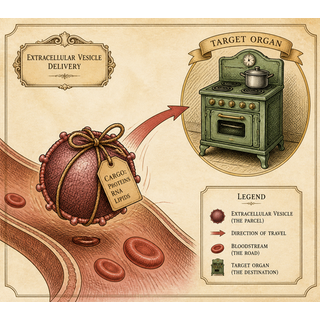
Tiny parcels, terrible recipes
If cells are kitchens, EVPs are the takeout containers they send to their neighbors. Inside, they can pack proteins, bits of RNA, lipids, and other molecular ingredients. Healthy cells use them too - this is not a crime unique to cancer. But tumor cells, being the sort of cooks who ignore the cookbook and set off the smoke alarm, can load these parcels with some very bad recipes.
That matters because cancer is not just a lump that sits there minding its own business. It behaves more like a pushy head chef yelling orders across the whole restaurant. Tumor-derived EVPs can travel through blood and lymph, deliver their cargo to faraway cells, and persuade those cells to change what they are doing. Sometimes that means calming down immune defenses. Sometimes it means making blood more likely to clot. Sometimes it means helping prepare a future metastatic site - basically setting the table before the uninvited guests arrive.
The pre-metastatic mise en place
One of the most interesting ideas here is the pre-metastatic niche. That is the notion that cancer can prep distant organs in advance, like chopping onions before the soup even hits the stove. EVPs seem to be one of the ways tumors do this.
Researchers have shown over the past several years that tumor-derived extracellular vesicles can reshape distant tissues, recruit supportive immune cells, alter blood vessels, and remodel the local environment in ways that make it easier for future cancer cells to settle in and grow. Reviews in high-impact journals have expanded this picture, showing that EVs are not just passive debris floating around like molecular Tupperware lids. They are active messengers with real influence over metastasis, immunity, and treatment response (Urabe et al., 2020), (Bebelman et al., 2024).
That is a little creepy, honestly. The tumor is not only cooking its own meal - it is sending prep instructions to a second kitchen across town.
Why your whole body gets dragged into it
This review makes a big point that cancer-associated EVPs do not stop at metastasis. They may help drive many of the systemic problems that make cancer so devastating.
Take thrombosis. Cancer can make the blood more clot-prone, and EVPs appear to be part of that process by carrying pro-coagulant signals (Leal et al., 2023). Or consider cachexia - the exhausting muscle and weight loss syndrome that can make patients feel as if their body is burning the pantry to stay warm. Tumor signals, including EV-associated cargo, may help trigger the metabolic rewiring behind that wasting state (Baracos et al., 2023).
The liver, nervous system, heart, and immune system can all get pulled into this. It is less like a single burnt casserole and more like one bad dish somehow wrecking every appliance in the house.
Not just cancer talking to itself
Another wrinkle - because of course cancer biology cannot just behave normally for five minutes - is that EVPs are not only coming from tumors. Host cells make them. Diet may influence them. Microbiota may shape them too. So now the story looks less like one chef ruining dinner and more like a whole neighborhood potluck where half the recipes got swapped and nobody labeled the containers.
That complexity matters for treatment. If EVPs help tumors hide from immunity, spread to new organs, or resist drugs, then targeting EVP production, release, uptake, or cargo could become a useful strategy. Some researchers are also exploring whether EVs could work as biomarkers in blood - a kind of liquid clue board for early detection or treatment monitoring (Kalluri and LeBleu, 2020), (Miura et al., 2021).
The big takeaway, without the lab-coat starch
What makes this review interesting is not just that EVPs are biologically important. It is that they force a bigger view of cancer. We often talk about tumors as if the whole problem lives in one scan, one biopsy, one organ. But this paper argues that cancer behaves more like a body-wide communication breakdown, with EVPs acting as some of the most meddlesome messengers in the room.
If future work backs this up - and turns these ideas into reliable tests or treatments - the payoff could be real. Better ways to spot metastasis early. Better ways to blunt cachexia or clotting risk. Better ways to treat not just the tumor, but the rest of the body that the tumor has been bossing around from afar.
Which, frankly, would be nice. Cancer has been acting like the kind of cook who trashes your kitchen, raids your fridge, and somehow leaves you apologizing to the guests. Shutting down its delivery service might be one way to finally take back the house.
References
-
Wang G, Lucotti S, Bojmar L, Tobias GC, Piszczatowski RT, Dror S, Zhang H, Lyden D. Systemic health impact of cancer-associated extracellular vesicles and particles. Nat Rev Cancer. 2026. doi: 10.1038/s41568-026-00952-w
-
Urabe F, Kosaka N, Yoshioka Y, Egawa S, Ochiya T. The small vesicular culprits: the investigation of extracellular vesicles as new targets for cancer treatment. Nat Rev Cancer. 2020;20(9):557-572. doi: 10.1038/s41568-020-0243-7
-
Kalluri R, LeBleu VS. The biology, function, and biomedical applications of exosomes. Science. 2020;367(6478):eaau6977. doi: 10.1126/science.aau6977
-
Miura Y, Yoshioka Y, Ochiya T. Extracellular vesicles: novel biomarkers and mediators of cancer progression. Nat Rev Clin Oncol. 2021;18(11):685-698. doi: 10.1038/s41467-021-23916-0
-
Leal AC, de Lima LG, Rocha RM, et al. Cancer-associated extracellular vesicles and thrombosis. Haematologica. 2023;108(9):2301-2314. doi: 10.3324/haematol.2022.281522
-
Baracos VE, Martin L, Korc M, Guttridge DC, Fearon KCH. Cancer-associated cachexia. Nat Rev Dis Primers. 2023;9:18. doi: 10.1038/s41572-023-00410-1
Disclaimer: The image accompanying this article is for illustrative purposes only and does not depict actual experimental results, data, or biological mechanisms.