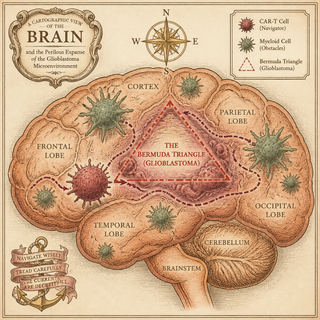
Glioblastoma has long occupied the same mental shelf as the Bermuda Triangle, the Zodiac cipher, and "why hospital billing looks like it was designed by a raccoon with a spreadsheet" - a place where good ideas go in and survival gains rarely come out. That is what makes a new Nature paper on GPNMB CAR-T cells worth a raised eyebrow and maybe even a cautiously optimistic drink.
This study tackles one of the nastiest problems in cancer biology: glioblastoma is not just a tumor, it is a whole bad neighborhood. The cancer cells are trouble enough, but the surrounding immune cells - especially myeloid cells - often end up acting less like cops and more like extremely compromised mall security. The paper’s central idea is clever: instead of aiming CAR-T cells at only the tumor, why not target both the glioblastoma cells and the tumor-supporting myeloid compartment using a marker called GPNMB?
That is not just biologically interesting. It is also economically attractive in the way a two-for-one coupon is attractive, except the coupon is for cellular therapy and the cashier is the FDA.
Why glioblastoma keeps ruining everyone’s week
Glioblastoma is the most aggressive common primary brain cancer in adults. Standard treatment usually means surgery, radiation, and temozolomide chemotherapy. Even when all of that goes as planned, the tumor often comes back like a subscription you definitely tried to cancel. Median survival is still grim, usually around 15 months in many modern series, and durable control remains rare.[1,2]
One reason is that glioblastoma is wildly heterogeneous. Different tumor cells can behave differently even within the same patient. So if you build a therapy against one target, the tumor may simply reroute around it like a smug GPS app. On top of that, the tumor microenvironment in glioblastoma is packed with myeloid cells - macrophages and related immune cells - that can suppress T-cell activity and help the tumor survive.[3]
So the old model of "find one tumor antigen, attack it, victory confetti" has not exactly showered us in confetti.
The trick here: hit the rebels and their enablers
The new paper focuses on GPNMB - glycoprotein nonmetastatic melanoma protein B - a surface protein found not only on glioblastoma cells but also on tumor-associated myeloid cells. That matters because it creates a shot at dual targeting. In plain English: one engineered T-cell product may be able to attack both the cancer cells and some of the local immune accomplices helping the tumor run its little criminal enterprise.[4]
According to the study, the researchers identified GPNMB as a compelling target in glioblastoma, then built CAR-T cells against it. Their data suggest these GPNMB CAR-T cells can recognize and kill GPNMB-expressing glioblastoma cells while also depleting GPNMB-positive myeloid cells in the tumor environment. In theory, that gives the therapy a second job. First, kill tumor cells. Second, make the neighborhood less hostile to T cells. Efficient. Almost suspiciously efficient.
That second job may be the key. CAR-T therapy has transformed some blood cancers, but solid tumors have been far more stubborn. T cells have trouble trafficking in, surviving, and staying functional inside these tumors. Glioblastoma is particularly hostile terrain - a biological escape room where every clue is covered in immunosuppressive slime.
Why this is interesting beyond the lab bench
What makes this paper more than a cool mechanistic story is that it addresses a broader failure mode in solid tumor immunotherapy: the cancer is not acting alone. If your treatment ignores the microenvironment, you may be trying to short a stock while the market makers are standing behind you with brass knuckles.
Recent reviews on CAR-T for glioblastoma have hammered this point. Antigen escape, poor persistence, and immunosuppressive myeloid populations remain major obstacles.[3,5] Meanwhile, work on myeloid biology in glioma keeps showing that these cells are not innocent bystanders - they shape therapy resistance and disease progression.[6]
If the dual-targeting concept holds up, it could represent a more realistic design principle for solid tumors: don’t just attack the malignant cells, disrupt the whole support economy.
The exciting part, and the cold shower
Now for the obligatory but necessary buzzkill: this is not the same thing as proving patients will live longer. Early-stage studies can look terrific before the clinic reminds everyone that cancer is a deeply unpleasant accountant. It notices every hidden cost.
CAR-T therapies are also expensive, logistically hard, and unevenly accessible. Even when they work, they tend to arrive wrapped in manufacturing complexity, specialized centers, and invoices that look like ransom notes. For glioblastoma, which progresses quickly, timing matters even more. A personalized therapy that takes too long to make can miss the clinical window entirely.
There is also the risk side. If GPNMB appears on normal tissues at meaningful levels, safety becomes a serious issue. In brain cancer, even "manageable toxicity" can stop sounding manageable very fast.
Still, the value proposition here is stronger than with many one-note targets. A therapy that attacks tumor cells and remodels the immune environment might earn its keep more convincingly than another precision product with a luxury price tag and bargain-bin durability.
The bigger takeaway
This paper does not solve glioblastoma. If it did, every neuro-oncologist on Earth would be dancing badly in the hallway right now. But it does push the field toward a smarter idea: treat glioblastoma as an ecosystem, not just a lump.
That shift matters. Cancer therapies often fail because they are too literal - they see the tumor cell and miss the crooked little economy around it. GPNMB CAR-T cells aim at both. In a disease where the usual returns on investment have been brutal, that is at least the kind of strategy worth watching closely.
References
-
Stupp R, Mason WP, van den Bent MJ, et al. Radiotherapy plus concomitant and adjuvant temozolomide for glioblastoma. N Engl J Med. 2005;352(10):987-996. doi:10.1056/NEJMoa043330
-
Tan AC, Ashley DM, López GY, et al. Management of glioblastoma: State of the art and future directions. CA Cancer J Clin. 2020;70(4):299-312. doi:10.3322/caac.21613
-
Choi BD, Maus MV, June CH, Sampson JH. Immunotherapy for glioblastoma: Adoptive T-cell strategies and beyond. Clin Cancer Res. 2019;25(7):2042-2048. doi:10.1158/1078-0432.CCR-18-1625
-
Savage N, Grewal S, Shaikh MV, et al. Dual tumour-myeloid targeting of glioblastoma with GPNMB CAR-T cells. Nature. 2026. doi:10.1038/s41586-026-10641-1
-
Labanieh L, Majzner RG, Mackall CL. Programming CAR-T cells to kill cancer. Nat Biomed Eng. 2023;7(4):393-415. doi:10.1038/s41551-023-01029-7
-
Andersen JK, Miletic H, Hossain JA. Tumor-associated macrophages in gliomas - biology, therapeutic opportunities, and challenges. Nat Rev Clin Oncol. 2021;18(6):373-390. doi:10.1038/s41571-020-00474-2
Disclaimer: The image accompanying this article is for illustrative purposes only and does not depict actual experimental results, data, or biological mechanisms.